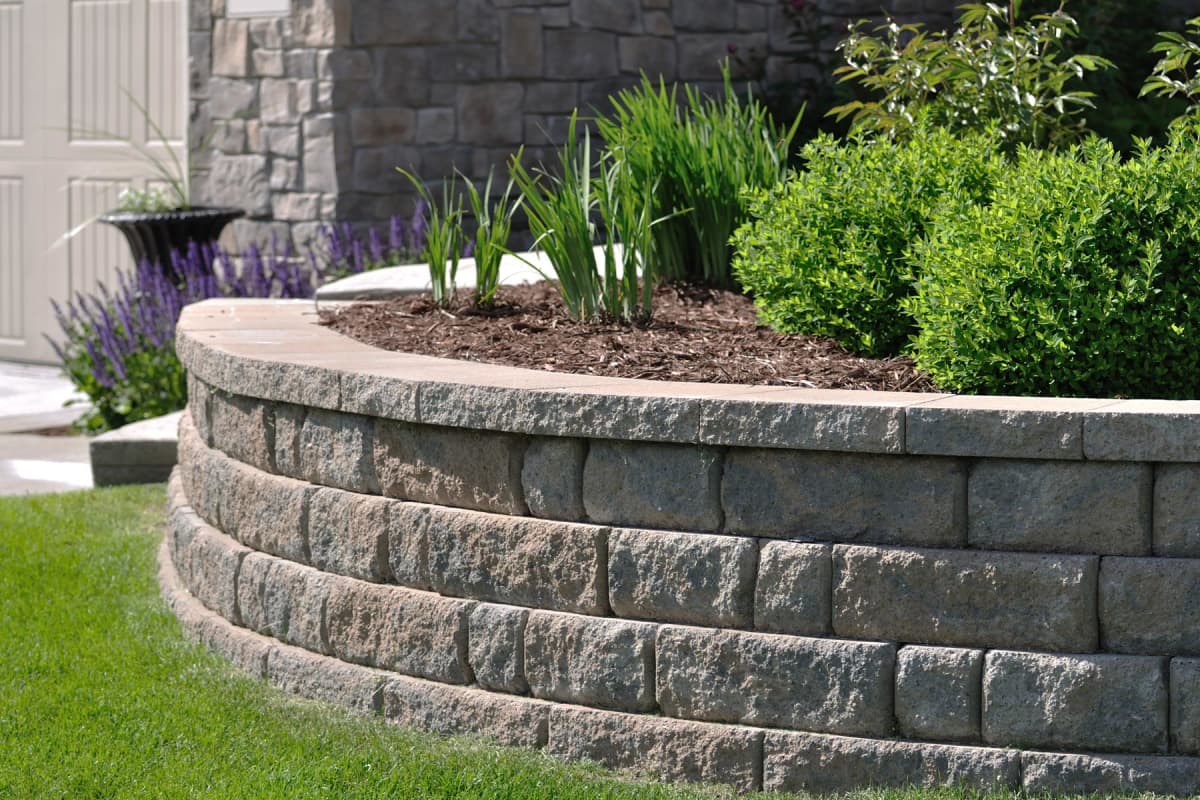
How much does a retaining wall cost?
How much does a retaining wall cost?
$35 – $65 average cost per square foot

Retaining wall cost
Building a retaining wall costs $35 to $65 per square foot on average, including the materials and professional labor. The total cost depends on the location, site conditions, and the wall type, material, length, and height. Retaining walls taller than 4 feet require additional engineering, permits, and deeper foundations, which significantly increase costs.
Most retaining wall contractors have a $1,500 to $3,000 project minimum.
| Wall length (linear feet) |
Average cost* (2' tall) |
Average cost * (4' tall) |
Average cost* (6' tall) |
|---|---|---|---|
| 10 | $700 – $1,300 | $1,400 – $2,600 | $2,100 – $3,900 |
| 15 | $1,050 – $1,950 | $2,100 – $3,900 | $3,150 – $5,850 |
| 25 | $1,750 – $3,250 | $3,500 – $6,500 | $5,250 – $9,750 |
| 50 | $3,500 – $6,500 | $7,000 – $13,000 | $10,500 – $19,500 |
| 100 | $7,000 – $13,000 | $14,000 – $26,000 | $21,000 – $39,000 |
| 150 | $10,500 – $19,500 | $21,000 – $39,000 | $31,500 – $58,500 |
| 200 | $14,000 – $26,000 | $28,000 – $52,000 | $42,000 – $78,000 |
*Most retaining wall contractors have a $1,500 to $3,000 project minimum.
What affects retaining wall prices?
Several factors influence the final cost of a retaining wall, including your location, the specific type of wall, the building materials you choose, and more.
Location
Your geographic area impacts both labor rates and material costs. Prices are typically higher in regions with higher costs of living. Shipping fees for materials can add hundreds of dollars if you're in a remote area or need specialty products.
Soil type also varies by location — rocky or clay-heavy soil requires more excavation work, increasing labor costs by up to 50%.
Type of retaining wall
Different retaining wall types serve different purposes and come with varying price tags. Segmental walls are the most popular choice for residential projects due to their ease of installation and attractive style options. However, other types may be more suitable depending on your property, needs, and preferences.
| Type | Average cost per square foot* | Details |
|---|---|---|
| Gravity | $20 – $50 |
|
| Segmental | $15 – $35 |
|
| Cantilevered | $40 – $80 |
|
| Sheet piling | $15 – $50 |
|
| Anchored | $50 – $150 |
|
*Including materials and professional labor
Wall material
The material choice dramatically impacts the upfront cost, appearance, and long-term value. Concrete retaining wall costs typically fall in the mid-range, making it the most popular choice for balancing affordability, durability, and aesthetic appeal. Wood offers a low initial cost but requires regular maintenance and eventual replacement.
The table below shows a comparison of popular retaining wall materials and prices:
| Material | Average cost per square foot* | Details |
|---|---|---|
| Vinyl | $10 – $20 |
|
| Concrete block wall | $15 – $40 |
|
| Wood/Timber wall | $15 – $30 |
|
| Poured concrete wall | $20 – $45 |
|
| Brick retaining wall | $30 – $60 |
|
| Steel/Metal | $40 – $150 |
|
| Natural stone wall | $20 – $95 |
|
*Including materials and professional labor
Labor
Labor makes up 40% to 60% of your total project cost, with professional contractors charging $50 to $75 per hour. The final labor cost depends heavily on site accessibility and project complexity. Walls over 4 feet require more skilled labor, deeper excavation, and potentially scaffolding or heavy equipment.
Accessibility
Accessibility dramatically affects labor costs. Easy-to-reach sites allow contractors to use machinery efficiently, while difficult terrain or tight spaces require more manual labor and time. Complex designs with curves, steps, or multiple tiers increase installation time and cost.
Permit and engineering requirements
Most cities require permits for retaining walls over 3 to 4 feet tall. Permits cost $50 to $450 depending on your location and the wall size. Your contractor should handle permit applications, but always confirm this is included in their quote.
Walls 4 feet or higher usually need a structural engineer's design to ensure safety and code compliance. Engineering fees range from $500 to $2,000+ depending on the project complexity. While these requirements add upfront costs, they're essential for preventing dangerous failures.
Site prep
Proper site preparation ensures your wall's longevity but adds to project costs.
Land clearing costs $1,200 to $8,000 per acre for basic vegetation removal.
If you have trees in the way, tree removal costs add $400 to $1,200.
Hiring an excavator costs $100 to $300 per hour to remove old walls or prepare the site.
Land grading to create a level base runs $0.40 to $2.00 per square foot.
Sloped yards need extensive excavation and may require terracing, potentially increasing costs by 50% or more.
New vs. rebuild
Building a new retaining wall on virgin ground is typically more straightforward than replacing an existing structure. If you're rebuilding, factor in demolition costs of $15 to $30 per linear foot and disposal fees for the old materials.
However, rebuilding offers opportunities to salvage materials in good condition or improve drainage systems that caused the original wall to fail. Some contractors offer discounts if you bundle demolition with new construction.
Drainage
Every retaining wall needs a drainage system to prevent water buildup behind the wall. Proper drainage prevents hydrostatic pressure that can cause walls to bow, crack, or collapse. Installing a French drain costs $10 to $85+ per linear foot depending on the complexity.
Basic drainage includes perforated pipes at the wall's base, gravel backfill, and weep holes to channel water away. For walls over 4 feet tall, professional drainage design is essential to prevent costly failures. Waterproofing adds $2 to $10 per square foot but extends your wall's life significantly.
Additional services
Beyond the basic wall construction, several add-ons can enhance the wall's functionality or appearance:
Concrete footings for taller walls cost $18 to $55 per linear foot.
Rebar reinforcement costs $1.50 to $2.50 per square foot but provides crucial structural support.
Decorative finishes like stamped concrete patterns cost an extra $5 to $15 per square foot, while stone or brick veneer runs $5 to $25 per square foot.
Cap stones provide a finished look and cost $5 to $15 per piece.

Retaining wall maintenance & long-term care
Regular maintenance extends your retaining wall's life and prevents expensive repairs. Catching issues early can save you thousands in repair costs.
Inspect your wall twice yearly for cracks, bulging, or water stains.
Clean drainage weep holes annually to ensure water flows freely.
Trim vegetation that grows too close, as roots can damage the structure.
Address small cracks immediately before water infiltration causes bigger problems.
For wood walls, reapply sealant every 2 to 3 years to prevent rot.
Check that downspouts and gutters direct water away from the wall.
Retaining wall FAQs
What is a retaining wall?
A retaining wall is a structure designed to hold back soil and prevent erosion on sloped properties. These walls create level areas for landscaping, patios, or driveways while managing water runoff and protecting your property's foundation.
Retaining walls work by resisting the lateral pressure of soil. They're essential for properties with elevation changes, preventing landslides and creating usable outdoor spaces. Beyond their practical function, well-designed retaining walls add visual interest and can increase property values.
How long do retaining walls last?
Retaining wall lifespan varies significantly by material choice and maintenance, ranging from 10 to 100+ years. However, with quality materials and expert installation, your wall should serve your property for decades.
| Wall material | Lifespan (years) |
|---|---|
| Concrete | 50 – 100 |
| Stone | 50 – 200 |
| Metal | 20 – 40 |
| Wood | 10 – 40 |
Proper installation and drainage are more important than material choice for longevity. Regular inspections help you catch small issues before they become expensive problems. Look for cracks, bulging, or water stains annually.
Hire experienced professionals to ensure proper installation, code compliance, and long-lasting results.
When do you need a retaining wall?
You need a retaining wall when sloped terrain causes erosion, drainage problems, or unusable space. Warning signs include soil washing away after rain, standing water near foundations, or difficulty maintaining slopes. Walls create level areas for patios and gardens while protecting your property. Call a professional if you notice cracks or soil movement.
Do retaining walls add home value?
Retaining walls offer exceptional ROI compared to many home improvements. Property appraisers estimate returns of 100% to 200% on well-designed walls using quality materials. They add functional space, prevent costly erosion damage, and enhance curb appeal.
Beyond financial returns, retaining walls provide immediate benefits: usable yard space, improved drainage, and peace of mind knowing your property is protected. They're particularly valuable in areas prone to heavy rainfall or on sloped lots where level ground is precious.

Getting estimates from retaining wall builders
When searching for a local landscaper or masonry contractor near you to build your retaining wall, be sure to:
Compare quotes from at least three licensed contractors who specialize in retaining walls.
Look for professionals certified by the Mason Contractors Association of America (MCAA) or the National Concrete Masonry Association (NCMA).
Ask for itemized estimates that break down material costs, labor, site prep, drainage, and any additional fees.
Check reviews on HomeGuide and Google and ask for references from similar projects.
Don't automatically choose the lowest bid. Experience and quality matter more than saving a few hundred dollars.
Questions to ask a contractor
Before hiring, ask these essential questions to protect your investment:
Are you licensed and insured for retaining wall construction?
How many years of experience do you have building walls similar to mine?
Can you provide references from recent projects I can contact?
What materials do you recommend for my specific situation and why?
Does your quote include all necessary permits, drainage systems, and site prep?
What's your timeline for completion, and what could cause delays?
Do you offer a warranty on your work, and what does it cover?
How do you handle unexpected site conditions or cost overruns?
Using our proprietary cost database, in-depth research, and collaboration with industry experts, we deliver accurate, up-to-date pricing and insights you can trust, every time.