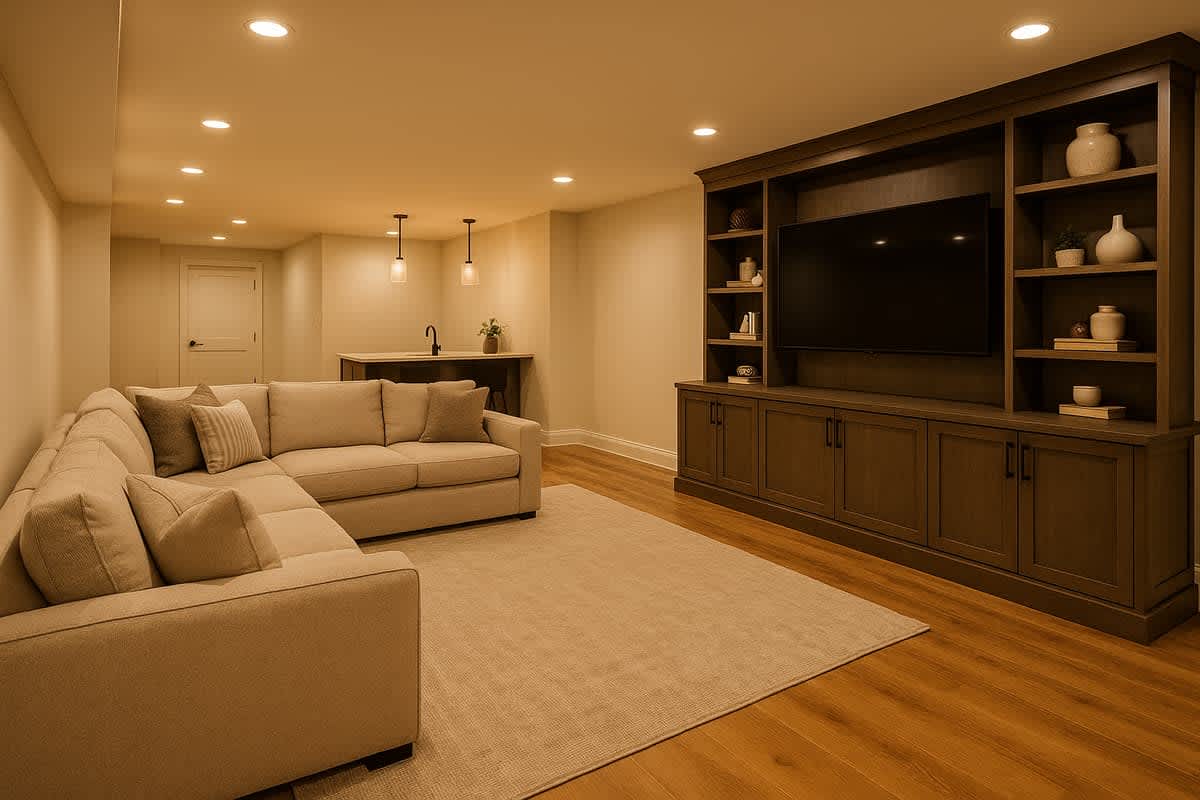
How much value does a finished basement add?
How much value does a finished basement add?
$20,000 – $55,000+ average value added
$30 – $75 value added per square foot
70% – 75% average ROI

Average value a finished basement adds
A finished basement typically adds 70% to 75% of the renovation cost back to your home's value. If you spend $50,000 on a basement renovation, you can expect your home's value to increase by roughly $35,000 to $37,500. While that's not a dollar-for-dollar return, the added livable square footage, improved functionality, and buyer appeal make it one of the more worthwhile home improvement projects.
| Factor | Details |
|---|---|
| Average ROI | 70% – 75% |
| Typical renovation cost | $30,000 – $75,000+ |
| Value added per square foot | $30 – $75 |
| Home value increase (average) | $20,000 – $55,000+ |
| Below-grade square footage value vs. above-grade | 50% – 60% |
The actual return depends on several factors, including your local real estate market, the quality of the renovation, and how the space is designed. In competitive housing markets where livable square footage is at a premium, a finished basement can push your home ahead of comparable listings and attract more serious buyers.
How much does it cost to finish a basement?
Basement finishing costs range from $30,000 on the low end for a basic build-out to well over $100,000 for high-end renovations in larger homes. The national average falls between $40,000 and $75,000, depending on the size of the space, the scope of work, and the finishes you choose.
| Renovation level | Cost per square foot | Total cost (1,000 sq. ft.) |
|---|---|---|
| Basic (drywall, flooring, lighting) | $30 – $50 | $30,000 – $50,000 |
| Mid-range (bathroom, kitchenette, custom finishes) | $50 – $75 | $50,000 – $75,000 |
| High-end (full kitchen, bedroom suite, premium materials) | $75 – $150+ | $75,000 – $150,000+ |
Basic projects typically include framing, insulation, drywall, flooring, lighting, and electrical work. Mid-range renovations add features like a bathroom, wet bar, or home office. High-end finishes may incorporate a full kitchen, bedroom suite with egress windows, home theater, or luxury materials throughout.
Costs also fluctuate based on existing conditions. If your basement needs waterproofing, foundation repair, or mold remediation before finishing work can begin, expect to add $5,000 to $15,000 or more to the total budget.
ROI by basement renovation type
Not every finished basement yields the same return. The way you use the space directly influences how much value appraisers and buyers assign to it. Some additions, like a bathroom or extra bedroom, consistently perform better than niche features like home theaters or wine cellars.
| Basement use | Estimated cost | Estimated ROI |
|---|---|---|
| Extra bedroom (with egress window) | $10,000 – $25,000 | 70% – 80% |
| Full bathroom | $15,000 – $35,000 | 70% – 75% |
| Family room / rec room | $20,000 – $40,000 | 65% – 75% |
| Home office | $5,000 – $15,000 | 60% – 70% |
| Home gym | $5,000 – $20,000 | 50% – 60% |
| Home theater | $15,000 – $50,000 | 50% – 65% |
| Wet bar or kitchenette | $5,000 – $20,000 | 60% – 70% |
| In-law suite / rental unit | $40,000 – $80,000 | 65% – 80% |
Adding a conforming bedroom with an egress window and a full bathroom tends to yield the highest return because these additions increase the official bedroom and bathroom count on the listing. A home that goes from "3-bed, 1-bath" to "4-bed, 2-bath" can jump into a higher price bracket entirely.
In-law suites and accessory dwelling units (ADUs) also perform well, especially in markets where rental income potential is a selling point. Niche installations like home theaters can deter buyers who don't share the same interests, limiting their resale value.
If resale value is a priority, design your finished basement with flexibility in mind. Open floor plans, neutral finishes, and multipurpose spaces appeal to the widest range of buyers. Highly personalized designs, like themed rooms or built-in gaming setups, can actually reduce your ROI.
Below-grade vs. above-grade square footage
Finished basement space is not valued equally to above-grade living space. Appraisers typically assign below-grade square footage 50% to 60% of the value per square foot compared to above-ground rooms. This distinction is one of the most important factors to understand before investing in a basement renovation.
| Square footage type | Value per square foot (example) | Appraisal treatment |
|---|---|---|
| Above-grade (main floors) | $150 – $300+ | Counted in gross living area (GLA) |
| Below-grade (finished basement) | $75 – $180 | Listed separately, not included in GLA |
According to appraisal standards, below-grade space cannot be included in the home's gross living area (GLA), regardless of how well it's finished. Even if your basement has the same hardwood floors, custom trim, and recessed lighting as the rest of your home, it will be listed and valued separately on the appraisal report.
This means a 2,000-square-foot home with a 1,000-square-foot finished basement won't be appraised as a 3,000-square-foot home. The basement adds value, but at a reduced rate. Buyers and their agents understand this distinction, so setting realistic expectations for your return is critical.
That said, a beautifully finished basement can still make your home more competitive. Buyers compare homes within price ranges, and having polished lower-level living space can tip the scales in your favor over similar homes without it.
Factors that affect your return
The 70% to 75% average ROI is just a benchmark. Several variables can push your actual return higher or lower. Understanding these factors helps you make smarter renovation decisions and avoid overspending on improvements the market won't reward.
| Factor | Impact on ROI |
|---|---|
| Local real estate market | High-demand markets yield higher returns |
| Quality of workmanship | Professional-grade work increases perceived value |
| Permits and code compliance | Unpermitted work can reduce value or kill deals |
| Ceiling height | Minimum 7-foot ceilings required for livable space |
| Natural light and egress | Windows and walkout access significantly boost value |
| Moisture and waterproofing | Signs of water damage or dampness reduce buyer confidence |
| Consistency with rest of home | Matching finishes throughout adds perceived value |
Local real estate market
Your location is the single biggest factor in determining ROI. In competitive markets where inventory is tight and square footage commands premium prices, a finished basement can add significant value. In slower markets or areas where basements are uncommon, the return may be lower.
Consulting a local real estate agent before starting renovations gives you a clearer picture of what buyers in your area are willing to pay for basement living space.
Quality of workmanship
Buyers can immediately tell the difference between professional craftsmanship and a DIY job. As real estate expert Bill Gassett of Maximum Real Estate Exposure advises, homeowners should match the same finishes throughout the rest of the house. Baseboards, moldings, and trim should be of similar size and quality as those found on the main level.
Cutting corners on materials or labor might save money upfront, but it creates a space that feels like a cheap knockoff rather than an integrated part of the home. This perception directly impacts what buyers will pay.
Permits and code compliance
Pulling proper building permits is essential. Many homeowners skip this step to save money, but it can backfire during a sale. A diligent buyer's agent will check permit records, and unpermitted work raises red flags. It can lead to renegotiation, lower offers, or deals falling apart entirely.
Retroactively obtaining permits after work is completed is often more difficult and expensive than doing it correctly from the start.
Unpermitted basement work can create serious problems at closing. Lenders may refuse to finance the purchase, buyers may demand price reductions, and you could be required to open walls for inspection. Always pull the necessary permits before starting construction.
Ceiling height and natural light
Most building codes require a minimum ceiling height of 7 feet for habitable space. Basements with 8-foot or 9-foot ceilings feel more spacious and command higher valuations. Low ceilings create a cramped feel that limits the space's appeal.
Natural light is equally important. Walkout basements with full-size windows or sliding glass doors are valued much more highly than fully underground spaces. Egress windows are not just a code requirement for bedrooms; they make the entire basement feel brighter and more inviting.
Moisture control
Any sign of water intrusion, musty smells, or moisture problems will erode buyer confidence and reduce your return. Before finishing a basement, invest in proper waterproofing, drainage, and dehumidification. A bone-dry basement with good air quality gives buyers peace of mind and protects your renovation investment.
Walkout basements vs. standard basements
Walkout basements consistently add more value than standard below-grade basements. Because walkout basements have at-grade access on at least one side, they receive more natural light, feel less like a basement, and in some markets are partially counted as above-grade square footage.
| Basement type | Typical ROI | Key advantage |
|---|---|---|
| Walkout (at-grade access on one side) | 75% – 85% | Natural light, separate entrance, higher appraisal value |
| Daylight (windows above grade on one side) | 70% – 78% | More light than standard, better livability |
| Standard (fully below grade) | 65% – 75% | Lowest cost to finish, but least natural light |
Walkout basements are especially valuable when configured as in-law suites or rental units because the separate entrance provides privacy and independence. In markets where ADUs and rental income are desirable, a finished walkout basement can yield returns approaching 85% or more.
Best renovations to maximize value
If your goal is to maximize the value a finished basement adds, focus on improvements that appeal to the broadest range of buyers while staying within a reasonable budget. The following upgrades consistently deliver the strongest returns.
| Upgrade | Estimated cost | Value impact |
|---|---|---|
| Add a full bathroom | $15,000 – $35,000 | Increases bathroom count on listing |
| Add a conforming bedroom with egress | $10,000 – $25,000 | Increases bedroom count on listing |
| Install luxury vinyl plank flooring | $3 – $7 per sq. ft. | Moisture-resistant, attractive, durable |
| Upgrade lighting (recessed, LED) | $2,000 – $5,000 | Eliminates the "dark basement" feel |
| Add egress windows | $2,500 – $5,000 each | Brings in natural light, meets code for bedrooms |
| Install a sump pump and dehumidifier | $1,500 – $4,000 | Buyer confidence in moisture control |
- Add a bathroom. A basement bathroom is one of the highest-value additions you can make. It adds convenience and increases the official bathroom count, which directly impacts listing price.
- Create a conforming bedroom. To count as a bedroom, the room needs a closet, minimum square footage, and an egress window. Meeting these requirements lets you add a bedroom to your listing, which significantly boosts value.
- Use moisture-resistant materials. Luxury vinyl plank, tile, and engineered wood outperform carpet and solid hardwood in basements. They resist moisture, look great, and reassure buyers.
- Invest in lighting. Recessed LED lighting throughout the basement eliminates shadows and creates a warm, welcoming atmosphere that makes the space feel like the rest of the home.
- Match finishes to the main level. Consistent baseboards, trim, paint colors, and flooring styles create a cohesive feel. The basement should look and feel like a natural extension of the home, not an afterthought.
When finishing a basement is not worth it
A finished basement isn't always a smart investment. In some situations, the cost outweighs the return, or the risks make the project impractical. Here are scenarios where you should reconsider.
- Chronic water problems. If your basement has persistent flooding, active leaks, or foundation cracks, remediation costs can make the total project prohibitively expensive. Finishing over moisture issues will lead to mold, structural damage, and costly repairs.
- Low ceiling heights. Basements with ceilings below 7 feet don't meet code for habitable space. Lowering the floor (underpinning or bench footing) costs $30,000 to $75,000+, which significantly reduces your net return.
- You plan to sell soon. If you're selling within the next year, you likely won't recoup the full investment. The lifestyle benefit of enjoying the space is a significant part of the equation, and a quick sale eliminates that benefit.
- Your neighborhood doesn't support it. In areas where homes with finished basements don't command meaningfully higher prices, or where basements are rare, the market may not reward your investment.
- You'd be over-improving. If finishing your basement would make your home the most expensive on the block by a wide margin, you'll struggle to recoup the cost. Appraisals are constrained by comparable sales in the area.
DIY vs. hiring a professional
Handling some of the work yourself can save 20% to 40% on labor costs, but basement finishing involves plumbing, electrical, HVAC, and framing work that typically requires licensed professionals and building permits.
| Approach | Potential savings | Risks |
|---|---|---|
| Full DIY | 30% – 40% | Code violations, poor quality, insurance issues |
| Hybrid (DIY cosmetic, hire for systems) | 15% – 25% | Coordination challenges, timeline delays |
| Full professional | 0% | Highest cost, but best quality and permit compliance |
A hybrid approach often makes the most sense. Handle cosmetic work like painting, installing trim, and laying click-lock flooring yourself. Then hire licensed professionals for electrical, plumbing, HVAC, and structural framing. This balances cost savings with quality and code compliance.
Keep in mind that professional-quality work consistently appraises higher and attracts more buyer interest. If you're finishing the basement primarily to increase resale value, the quality of execution directly impacts your return.
How appraisers evaluate a finished basement
Understanding how appraisers assess finished basement space helps you make renovation choices that translate into measurable value on paper, not just visual appeal.
| Appraisal factor | What appraisers look for |
|---|---|
| Square footage classification | Below-grade space listed separately from GLA |
| Finish quality | Comparable to above-grade living areas |
| Functionality | Bathroom, bedroom, and living space configurations |
| Code compliance | Permits, egress, ceiling height, smoke detectors |
| Comparable sales | Nearby homes with similar finished basements |
Appraisers compare your finished basement to comparable properties in the area that also have finished lower levels. If few comparable homes have finished basements, the appraiser has less data to support a higher valuation, which can limit your return.
They also evaluate the quality of the finish. A basement with proper insulation, drywall, flooring, adequate lighting, and HVAC is valued much higher than one with exposed ductwork, bare concrete, or incomplete finishes. Functional additions like bathrooms and bedrooms with egress receive the most weight.
Frequently asked questions
Does a finished basement count as square footage?
A finished basement adds livable space, but it does not count toward the home's gross living area (GLA) in appraisals. Below-grade square footage is listed separately and valued at roughly 50% to 60% of above-grade space per square foot.
How much does a finished basement increase home value?
On average, a finished basement increases home value by 70% to 75% of the renovation cost. A $50,000 renovation typically adds $35,000 to $37,500 in value. Walkout basements and those with bathrooms and bedrooms tend to return more.
Is it better to finish a basement or add a room?
Above-grade additions are valued higher per square foot, but they also cost significantly more. Finishing a basement typically runs $30 to $75 per square foot compared to $100 to $300+ per square foot for a new addition. The basement offers more affordable square footage, while an addition provides higher per-square-foot value.
Do buyers prefer finished basements?
Yes. Most buyers view a finished basement as a significant plus, especially when it includes a bathroom, flexible living space, and quality finishes. Homes with finished basements tend to sell faster and attract more interest than comparable homes without them.
Should I finish my basement before selling?
It depends on your timeline and budget. If you can complete the renovation at least a year or two before selling, you'll benefit from both the lifestyle improvement and the increased sale price. If you're selling within months, a partial finish or cosmetic cleanup may be more cost-effective than a full renovation.
What is the cheapest way to finish a basement?
The most budget-friendly approach focuses on essentials: framing, insulation, drywall, basic flooring (luxury vinyl plank), recessed lighting, and paint. Skip expensive built-ins and custom features. A basic finish for a 1,000-square-foot basement can cost $30,000 to $40,000 with a mix of DIY cosmetic work and professional trades.