![How to Become a Stonemason [PRO]](https://res.cloudinary.com/liaison-inc/image/upload/f_auto/q_auto:eco,w_1200:eco,w_1200/v1771235151/content/homeguide/homeguide-how-to-become-a-stone-mason-carving-stone-with-hammer-and-chisel.jpg)
How to Become a Stonemason [PRO]
How to Become a Stonemason [PRO]

What is a stonemason?
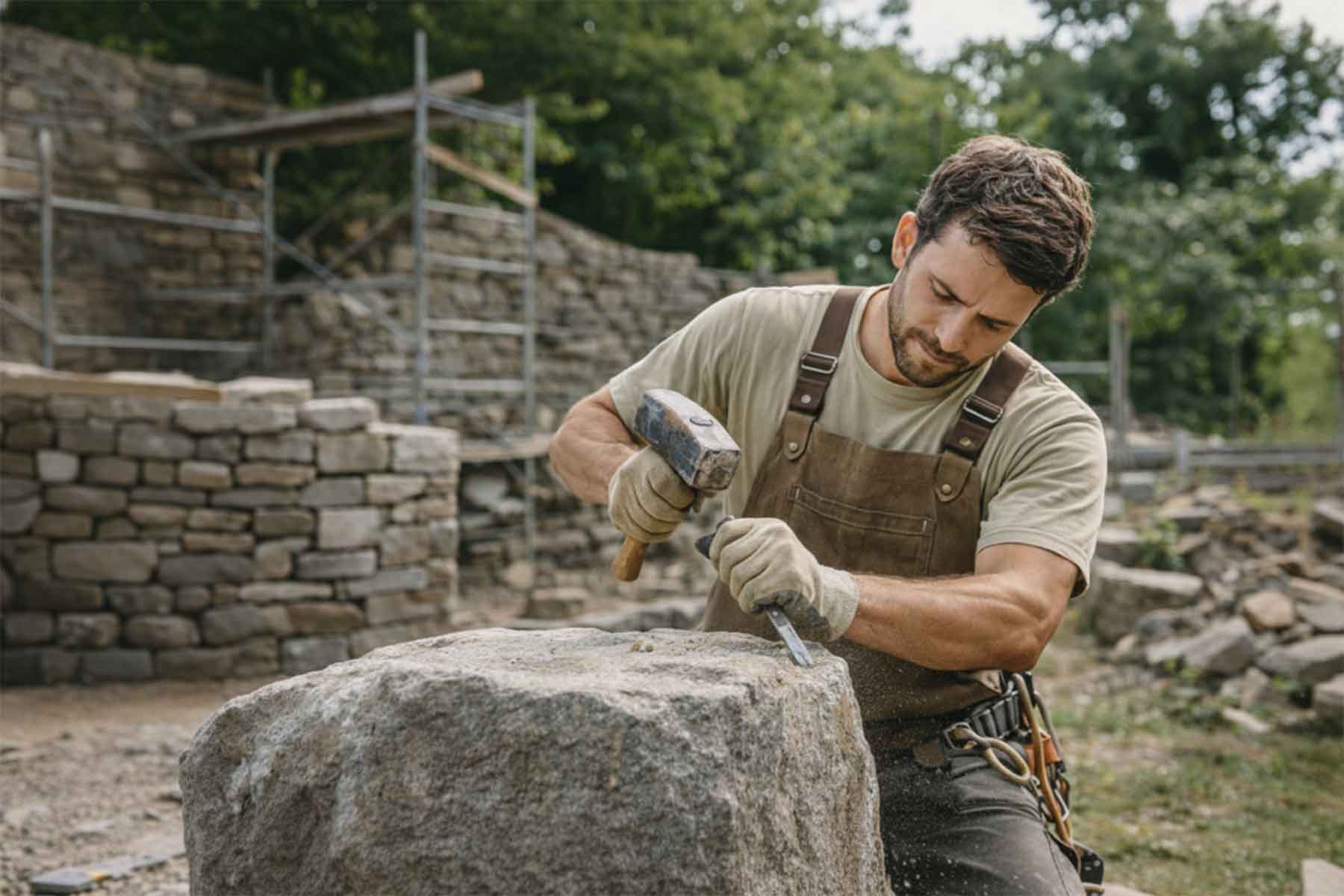
A stonemason is a skilled tradesperson who cuts, shapes, and builds structures using natural and artificial stone. These craftspeople work with materials like granite, marble, limestone, and concrete blocks to construct or restore buildings, bridges, monuments, and decorative features.
Unlike other construction roles, stonemasonry is often considered an art form. It requires a keen eye for shape, color, and texture. These professionals are the backbone of both historic preservation and modern luxury architecture.
The trade has existed for thousands of years, and it's still very relevant today. Modern stonemasons preserve this ancient craft while incorporating new tools and techniques.
What does a stonemason do?
Stonemasons combine craftsmanship with construction know-how. The job is both physical and precise. Depending on their specialty and the project requirements, daily tasks often include:
Reading blueprints and layout drawings
Measuring and marking stone for cutting
Cutting and shaping stone using saws, chisels, and grinders
Mixing mortar and setting stone in place
Repairing or restoring older masonry
Working safely with heavy materials and equipment
Some masons focus on new construction. Others specialize in restoration, monuments, or decorative stonework. You'll usually work outdoors or on job sites, often in teams with other trades.
How to become a stonemason (step-by-step)
Breaking into stonemasonry requires dedication and proper training. Here's a clear roadmap you can follow.
Step 1: Finish high school or earn a GED
Most employers and apprenticeship programs require a high school diploma or equivalent. Classes in math, shop, or drafting are especially helpful, since measuring and layout skills are essential in masonry.
Math skills are particularly important, as you'll use them daily to calculate materials, read measurements, and ensure proper proportions. Take advantage of any construction-related courses your school offers.
Step 2: Gain relevant experience
Before entering an apprenticeship, consider gaining hands-on experience in construction to build both physical and practical skills. Many aspiring stonemasons start as construction laborers, bricklayers, or mason tenders.
This entry-level work helps you understand job site safety, familiarize yourself with tools and materials, and determine if the physical demands suit you. Even volunteering on restoration projects or helping family members with masonry work can provide valuable exposure.
Step 3: Complete a masonry apprenticeship program
Masonry apprenticeship programs are the primary pathway to becoming a professional stonemason. These programs combine on-the-job training with classroom instruction in an earn-while-you-learn format.
Most apprenticeships last three to four years and require:
Minimum age of 18 years
High school diploma or GED
Physical ability to perform demanding work
Around 6,000 hours of on-the-job training
At least 144 hours of classroom instruction annually
You'll learn blueprint reading, safety regulations, stone cutting and shaping techniques, mortar mixing, and proper tool usage. Many programs are sponsored by unions like the International Union of Bricklayers and Allied Craftworkers or contractor associations.
Most apprenticeship programs are completely free, and you earn a salary while training. Your pay typically increases as you advance through each level of the apprenticeship.
Step 4: Consider technical school training
Some stonemasons supplement their apprenticeship with technical school programs. Many vocational schools and community colleges offer one- to two-year masonry programs covering basic skills and techniques.
These programs can be completed before entering an apprenticeship, during your training, or as part of on-the-job education. Credits earned often count toward an associate's degree, providing additional credentials for your career.
Step 5: Develop essential skills
Successful stonemasons master both technical and soft skills throughout their training. Key abilities include:
Mathematical proficiency for reading blueprints, calculating materials, and ensuring accurate measurements. You'll use geometry and basic algebra regularly.
Hand-eye coordination to apply mortar evenly, align stones precisely, and use tools safely. This skill develops with practice and experience.
Problem-solving abilities to overcome challenges like adverse weather, material shortages, or unexpected structural issues. Creativity helps you find solutions while maintaining quality.
Teamwork and communication since you'll collaborate with other masons, construction workers, and clients. Clear communication ensures project success and workplace safety.
Physical strength and stamina for lifting heavy materials, working in various positions, and maintaining focus during long workdays.
Step 6: Pursue certification (optional)
While not required, professional certifications demonstrate expertise and can boost your career prospects. Organizations offering stonemason certifications include:
The National Center for Construction Education and Research (NCCER) provides certification programs covering safety, materials, tools, layout, cutting, and finishing.
The Mason Contractors Association of America (MCAA) offers certifications focused on installation, repair, and restoration of natural stone.
The Stone Foundation provides training in traditional stonework techniques, particularly valuable for heritage and restoration work.
Step 7: Choose a specialty or advance your career
Once you've built a solid foundation of skills and on-the-job experience, you can start shaping your career in the direction that fits your interests and income goals.
With experience, you can:
Specialize in restoration or historic masonry.
Move into supervision or foreperson roles.
Start your own contracting business.
Expand into brick or concrete masonry.
Many professionals branch into becoming multi-skilled masons to increase job opportunities.
Stonemason salary and career outlook
The masonry field offers a solid middle-class wage with room to grow. The average annual salary ranges from $48,000 to $65,000. Entry-level workers start below this range, while experienced stonemasons can earn $70,000+. Income also depends on your location, specialty skills, certifications earned, and whether you work union or non-union jobs.
It's important to note that wages fluctuate based on the industry as well. For instance, those working for nonresidential building contractors often see higher average earnings.
Job outlook
Overall employment for masonry workers (which includes brickmasons, blockmasons, stonemasons, terrazzo workers, etc.) is projected to grow about 2% over the next decade, which is slower than the average for all occupations. However, there are still roughly 20,700 job openings each year as veterans of the trade retire or move into management.
Demand remains steady for residential construction, decorative stonework, and historic restoration, with particularly strong opportunities for stonemasons specializing in heritage and conservation work. Because these projects require specialized skills, restoration specialists often face less competition and have steadier work when the construction market slows.
FAQs about becoming a stonemason
How long does it take to become a stonemason?
Becoming a fully qualified stonemason takes 3 to 4 years through an apprenticeship program. This includes both on-the-job training and classroom instruction. Some people learn informally over a longer period, but apprenticeships provide the most comprehensive training.
Do I need a college degree to become a brick mason?
No, you don't need a college degree. Most stonemasons enter the field with a high school diploma or GED and learn through apprenticeships. However, some choose to complete technical school programs or earn associate's degrees, which can provide additional credentials and advancement opportunities.
Can women become stonemasons?
Absolutely! While stonemasonry has traditionally been a male-dominated field, women are increasingly entering the trade. The physical demands are significant, but with proper technique and training, people of various builds and strengths can succeed. Many apprenticeship programs actively encourage applications from women and underrepresented groups.
What's the difference between a stonemason and a bricklayer?
While both are masonry professionals, stonemasons specialize in working with natural and cut stone, while bricklayers focus primarily on bricks and concrete blocks. Many professionals learn both skills during their apprenticeships, and some stonemasons start as bricklayers before specializing in stonework.
Using our proprietary cost database, in-depth research, and collaboration with industry experts, we deliver accurate, up-to-date pricing and insights you can trust, every time.