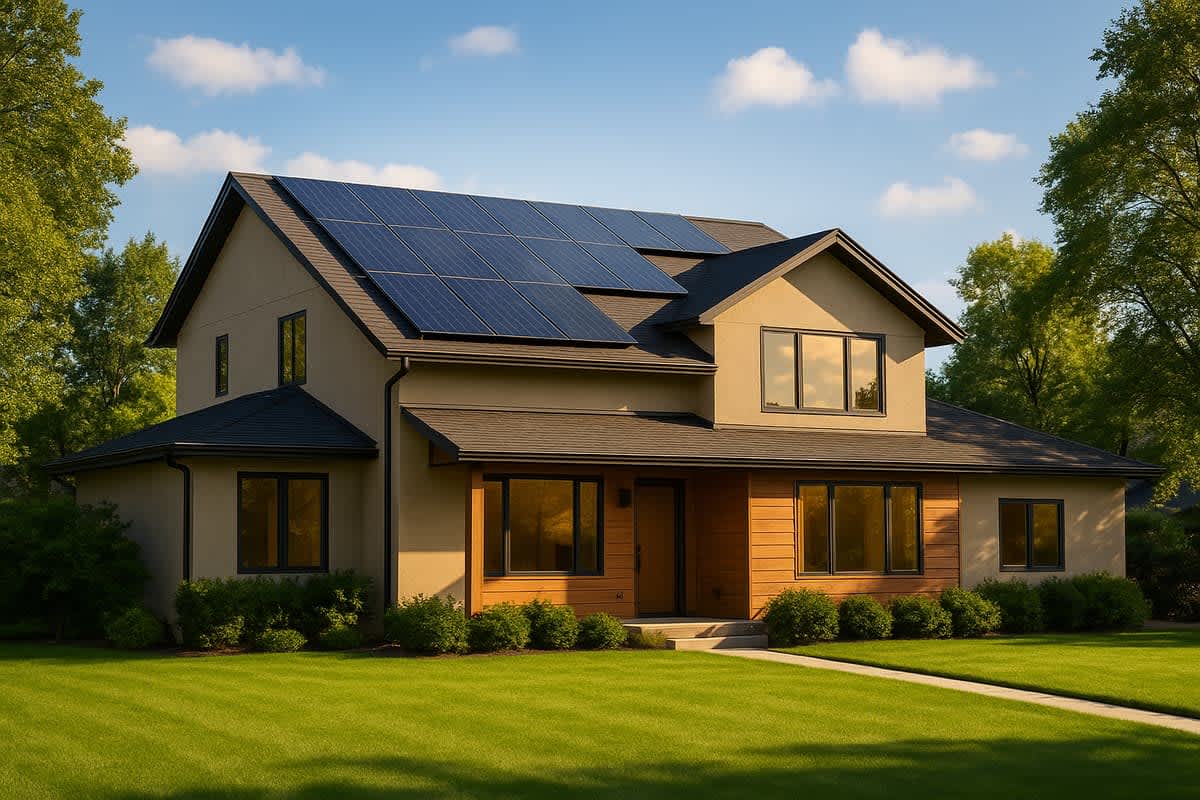
Are solar panels worth it?
Are solar panels worth it?
$10,500 – $17,500 after tax credit
$20,000 – $96,000 lifetime savings
$50 – $150 average monthly savings

Average cost and savings of solar panels
Yes, solar panels are worth it for most homeowners. A typical residential solar panel system costs $15,000 to $25,000 before incentives, but after the 30% federal solar tax credit, that drops to $10,500 to $17,500. Most homeowners save $20,000 to $96,000 over the 25- to 30-year lifespan of their system, with a payback period of 6 to 12 years depending on location, electricity rates, and energy usage.
That said, solar panels aren't the right choice for every home. Factors like roof condition, shading, local electricity costs, and available incentives all play a role in whether the investment makes financial sense for you.
| Factor | Details |
|---|---|
| Average system cost (before incentives) | $15,000 – $25,000 |
| Average system cost (after 30% tax credit) | $10,500 – $17,500 |
| Average monthly savings | $50 – $150 |
| Typical payback period | 6 – 12 years |
| Lifetime savings (25–30 years) | $20,000 – $96,000 |
| System lifespan | 25 – 30+ years |
| Federal tax credit (ITC) | 30% |
How solar panels work
Solar panels convert sunlight into electricity using photovoltaic (PV) cells. When sunlight hits these cells, it causes electrons to move, creating a flow of direct current (DC) electricity. An inverter then converts that DC electricity into alternating current (AC), which powers your home's appliances, lights, and electronics.
Any excess electricity your system generates can be sent back to the grid through a process called net metering. Your utility company credits you for that exported energy, effectively spinning your meter backward. On cloudy days or at night, you draw power from the grid as usual, using those credits to offset the cost.
Modern solar panels work in a variety of weather conditions, not just bright sunshine. While direct sunlight produces the most energy, panels still generate electricity on overcast days, though at reduced efficiency (typically 10% to 25% of their rated capacity).
Benefits of solar panels
Solar panels offer financial, environmental, and practical advantages that make them appealing to homeowners. The most compelling benefit for most people is the reduction in monthly electricity bills, but the advantages extend well beyond that.
| Benefit | Details |
|---|---|
| Lower electricity bills | Reduce monthly bills by 50% – 100% |
| Increased home value | Adds approximately $15,000 – $25,000 in resale value |
| Energy independence | Protection from rising utility rates |
| Environmental impact | Offsets 3 – 4 tons of carbon emissions per year |
| Low maintenance | Minimal upkeep; occasional cleaning and inspections |
| Net metering credits | Get paid or credited for excess energy exported to the grid |
Significant electricity bill savings
The primary financial benefit of solar panels is a dramatic reduction in your electricity bill. Depending on system size, energy consumption, and local utility rates, homeowners can cut their electricity costs by 50% to 100%. In states with high electricity rates like California, Massachusetts, and New York, the savings are even more pronounced.
As utility rates continue to rise (historically at about 2% to 3% per year nationally), your savings increase over time. A system that saves you $100 per month today could be saving you $150 or more per month a decade from now.
Increased property value
Studies from the Lawrence Berkeley National Laboratory and Zillow show that homes with solar panels sell for more than comparable homes without them. On average, solar panels add about 4% to a home's value. For a $400,000 home, that's an additional $16,000 in resale value.
This increase tends to be strongest in markets with high electricity costs and strong solar adoption. Owned systems (not leased) provide the greatest boost, since buyers inherit the savings without taking on lease obligations.
Protection from rising energy costs
Electricity prices in the United States have risen steadily over the past two decades. By generating your own power, you lock in your energy costs and insulate yourself from future rate hikes. This energy independence becomes increasingly valuable over the 25- to 30-year lifespan of your system.
Environmental benefits
A typical residential solar system offsets roughly 3 to 4 tons of carbon dioxide per year. Over 25 years, that's equivalent to planting over 100 trees. Solar energy produces no greenhouse gas emissions during operation and requires no water to generate electricity, unlike many traditional power sources.
Low maintenance requirements
Solar panels have no moving parts, which means they require very little maintenance. Most manufacturers recommend cleaning them once or twice a year and having a professional inspection every few years. Many systems come with 25-year warranties on the panels and 10- to 15-year warranties on inverters.
Drawbacks of solar panels
Solar panels aren't perfect for every situation. High upfront costs, roof limitations, and variable savings depending on location are legitimate concerns worth evaluating before committing to an installation.
| Drawback | Details |
|---|---|
| High upfront cost | $15,000 – $25,000 before incentives |
| Long payback period | 6 – 12 years to recoup investment |
| Roof suitability | Not all roofs have proper orientation, angle, or structural integrity |
| Weather dependence | Production drops significantly on cloudy days and during winter months |
| Inverter replacement | May need replacement at $1,000 – $2,000 after 10–15 years |
| Moving complications | Panels are expensive to relocate; most homeowners leave them when selling |
Significant upfront investment
Even after the 30% federal tax credit, a solar panel system still represents a substantial investment of $10,500 to $17,500 for most homeowners. While financing options exist, they add interest costs that can eat into your overall savings. If you plan to move within the next five to seven years, you may not recoup the full investment.
Roof condition and orientation matter
Solar panels perform best on south-facing roofs with a pitch of 15 to 40 degrees and minimal shading. If your roof faces north, is heavily shaded by trees or neighboring buildings, or needs replacement soon, solar may not be a good fit. In some cases, it may require additional investment in roof repairs before installation.
Older roofs should be replaced before solar installation, since removing and reinstalling panels later adds $1,500 to $6,000 in costs.
Reduced production in certain climates
While solar panels work in all 50 states, production varies significantly by location. Homes in the Pacific Northwest or Northeast will generate less electricity than homes in the Southwest. That said, states like Massachusetts and New Jersey still rank among the best for solar due to high electricity rates and strong incentive programs, proving that sunshine alone doesn't determine value.
Potential inverter replacement
While solar panels themselves typically last 25 to 30 years, the inverter (which converts DC to AC electricity) usually needs replacement after 10 to 15 years. This adds an extra $1,000 to $2,000 to your total cost of ownership. Some newer microinverter systems offer longer warranties, but they come at a higher initial price.
How much do solar panels cost?
The average cost of a residential solar panel system in 2025 is $2.50 to $3.50 per watt before incentives. For a standard 6 kW to 10 kW system, that translates to $15,000 to $35,000 before the federal tax credit. After applying the 30% credit, most homeowners pay $10,500 to $24,500 out of pocket.
| System Size | Before Tax Credit | After 30% Tax Credit |
|---|---|---|
| 4 kW (small home) | $10,000 – $14,000 | $7,000 – $9,800 |
| 6 kW (average home) | $15,000 – $21,000 | $10,500 – $14,700 |
| 8 kW (larger home) | $20,000 – $28,000 | $14,000 – $19,600 |
| 10 kW (large home or high usage) | $25,000 – $35,000 | $17,500 – $24,500 |
| 12 kW+ (very high usage) | $30,000 – $42,000 | $21,000 – $29,400 |
Factors that affect solar panel costs
Several variables influence your total installation cost:
- System size: Larger systems cost more overall but less per watt.
- Panel type: Monocrystalline panels are about 20% more expensive than polycrystalline but offer higher efficiency.
- Roof complexity: Multi-level roofs, steep pitches, or unusual shapes increase labor costs.
- Location: Costs vary by state due to labor rates, permitting fees, and local demand.
- Inverter type: String inverters cost less, while microinverters and power optimizers add $1,000 to $2,000.
- Battery storage: Adding a solar battery adds $5,000 to $15,000 to the total project cost.
Solar incentives and tax credits
Federal and state incentives can reduce the cost of going solar by 30% to 50% or more. The federal Investment Tax Credit (ITC) is the single largest incentive available, and many states, utilities, and municipalities offer additional programs that stack on top of it.
| Incentive | Value |
|---|---|
| Federal solar tax credit (ITC) | 30% of total system cost |
| State tax credits (varies) | $500 – $5,000+ |
| Net metering | Credits on your bill for exported electricity |
| Solar Renewable Energy Credits (SRECs) | $10 – $400+ per credit (varies by state) |
| Local utility rebates | $500 – $2,500 |
| Property tax exemptions | Solar added value exempt from property taxes (many states) |
Federal solar tax credit (ITC)
The federal Investment Tax Credit allows you to deduct 30% of the total cost of your solar installation from your federal income taxes. For a $20,000 system, that's a $6,000 tax credit. This credit is available through 2032, after which it steps down to 26% in 2033 and 22% in 2034.
The federal solar tax credit is a tax credit, not a refund. You need to owe enough in federal income taxes to take full advantage of it. If your tax liability is less than the credit amount, you can roll the remaining balance forward to the following tax year.
Net metering
Net metering allows you to send excess electricity your panels generate back to the grid in exchange for credits on your utility bill. When your panels produce more than you use (typically during midday), the surplus flows to the grid. At night or on cloudy days, you draw from the grid and use those credits to offset the cost.
Net metering policies vary significantly by state. Some states offer full retail rate credits, while others offer reduced rates. Check your state's current net metering policy, as some utilities are shifting to less favorable compensation structures.
State and local incentives
Many states offer additional incentives on top of the federal tax credit. Some of the most generous programs include:
- New York: State tax credit of up to $5,000 plus additional utility rebates.
- Massachusetts: SMART program payments and SRECs worth hundreds per year.
- California: Net billing program and self-generation incentive for battery storage.
- New Jersey: SRECs that can earn $1,000+ per year.
- Illinois: Illinois Shines program with upfront or ongoing incentive payments.
How long does it take for solar panels to pay for themselves?
The average solar payback period in the United States is 6 to 12 years. This means most homeowners start seeing pure profit from their solar investment well before the panels reach the end of their useful life. After the payback period, the electricity your system generates is essentially free.
| Factor | Effect on Payback Period |
|---|---|
| High electricity rates (over $0.15/kWh) | Shorter payback (5 – 8 years) |
| Low electricity rates (under $0.10/kWh) | Longer payback (10 – 15+ years) |
| Strong state incentives | Shorter payback (5 – 8 years) |
| No state incentives | Longer payback (9 – 12 years) |
| High sun exposure (Southwest) | Shorter payback (6 – 9 years) |
| Low sun exposure (Northwest) | Longer payback (10 – 14 years) |
| Full net metering available | Shorter payback |
| No net metering | Longer payback |
Calculating your payback period
To estimate your solar payback period, use this simple formula:
Payback period = (Total system cost after incentives) ÷ (Annual electricity savings + annual incentive payments)
For example, if your system costs $16,000 after the federal tax credit and saves you $1,800 per year in electricity, your payback period is roughly 8.9 years. Any state incentives, SRECs, or net metering credits would shorten that further.
Best and worst states for solar
Your location significantly impacts whether solar panels are worth the investment. States with high electricity rates, strong incentives, and good sun exposure offer the fastest returns, while states with cheap electricity and minimal incentives make the math harder to justify.
| Best States for Solar | Average Payback Period | Key Factors |
|---|---|---|
| California | 5 – 7 years | High electricity rates, strong sun exposure |
| Massachusetts | 5 – 7 years | High rates, SMART program, SRECs |
| New Jersey | 5 – 8 years | SRECs, strong net metering |
| New York | 6 – 8 years | State tax credit, high rates |
| Arizona | 6 – 8 years | Excellent sun exposure, rising rates |
| Texas | 7 – 9 years | Strong sun exposure, growing incentives |
| Worst States for Solar | Average Payback Period | Key Factors |
|---|---|---|
| Louisiana | 12 – 16 years | Low electricity rates, limited incentives |
| North Dakota | 12 – 15 years | Low sun exposure, cheap electricity |
| West Virginia | 12 – 16 years | Low rates, no state incentives |
| Alabama | 11 – 15 years | Limited net metering, low rates |
Should you buy, lease, or finance solar panels?
Buying solar panels outright offers the highest long-term return, but leasing and financing make solar accessible to homeowners who can't afford the upfront cost. Each option has trade-offs in terms of savings, ownership, and eligibility for incentives.
| Option | Upfront Cost | Lifetime Savings | Own the System? | Eligible for Tax Credit? |
|---|---|---|---|---|
| Cash purchase | $10,500 – $24,500 | Highest | Yes | Yes |
| Solar loan | $0 | High (reduced by interest) | Yes | Yes |
| Solar lease | $0 | Moderate | No | No |
| Power Purchase Agreement (PPA) | $0 | Moderate | No | No |
Cash purchase
Buying outright maximizes your savings because you avoid interest payments, qualify for the full federal tax credit, and own all the electricity your system produces. A cash purchase delivers the shortest payback period and the highest lifetime return on investment.
Solar loans
Solar loans let you own the system with no money down. You still qualify for the federal tax credit, which many homeowners use to pay down the principal. Interest rates on solar loans typically range from 3% to 8%, and loan terms run 10 to 25 years. The key is ensuring your monthly loan payment is less than what you were paying for electricity.
Solar leases and PPAs
With a lease or power purchase agreement (PPA), a third-party company owns the panels on your roof. You pay a fixed monthly fee (lease) or a per-kilowatt-hour rate (PPA) that is typically 10% to 30% lower than your current electricity rate. While savings are smaller compared to ownership, these options work well for homeowners who don't qualify for the tax credit or prefer no upfront costs.
Solar leases can complicate the home selling process. Some buyers are hesitant to assume a lease, and the lease company may require approval of the new homeowner. If you plan to sell your home within the next several years, purchasing rather than leasing is typically the better option.
Do solar panels increase home value?
Yes. According to a Zillow study, homes with solar panels sell for approximately 4.1% more than comparable homes without them. For the median U.S. home valued at around $400,000, that translates to roughly $16,400 in added value. A Lawrence Berkeley National Laboratory study found that buyers are willing to pay a premium of about $15,000 for a home with an average-sized solar system.
The value increase depends on several factors:
- System ownership: Owned systems add more value than leased systems.
- System age: Newer systems with longer remaining warranty periods command higher premiums.
- Local electricity rates: Higher rates make solar-equipped homes more attractive to buyers.
- Market demand: Areas with high solar adoption see stronger premiums.
Solar batteries: are they worth adding?
Solar batteries cost $5,000 to $15,000 installed and store excess solar energy for use during nighttime hours, power outages, or peak rate periods. Whether a battery is worth the added expense depends on your utility's rate structure, net metering policy, and how much you value backup power.
| Battery Consideration | Details |
|---|---|
| Average cost (installed) | $5,000 – $15,000 |
| Popular options | Tesla Powerwall, Enphase IQ, LG RESU |
| Capacity | 10 – 15 kWh (typical) |
| Warranty | 10 – 15 years |
| Best for | Time-of-use rates, frequent outages, no net metering |
Batteries make the most financial sense in areas with time-of-use electricity rates, where you can store cheap solar energy and use it during expensive peak hours. They also provide peace of mind during power outages, keeping essential appliances running when the grid goes down.
In areas with strong net metering at full retail rates, batteries are harder to justify financially since the grid essentially acts as a free battery. However, as more utilities reduce net metering compensation, batteries are becoming increasingly attractive.
When solar panels are NOT worth it
While solar works well for most homeowners, there are specific situations where the investment doesn't make sense. Understanding these scenarios can save you from a costly mistake.
- Your roof needs replacement soon: If your roof has less than 10 years of life remaining, replace it first. Removing and reinstalling panels costs $1,500 to $6,000.
- Heavy shading: If your roof is heavily shaded by trees or tall buildings for most of the day, your panels won't produce enough energy to justify the cost.
- Very low electricity bills: If you're already paying less than $50 per month for electricity, the savings from solar may not cover the cost of the system within a reasonable timeframe.
- You plan to move soon: If you're selling your home within the next three to five years, you likely won't recoup the installation cost, even with the added home value.
- Your roof faces north: North-facing roofs in the Northern Hemisphere receive significantly less sunlight, reducing energy production by 20% to 30% or more compared to south-facing roofs.
- Low electricity rates with no incentives: If you live in a state with electricity rates under $0.10 per kWh and no meaningful state incentives, the payback period can stretch beyond 15 years.
How to determine if solar is worth it for your home
The best way to evaluate solar for your specific situation is to gather a few key data points and compare costs to potential savings. Here's a step-by-step approach:
- Check your electricity bill: Look at your average monthly usage in kilowatt-hours (kWh) and what you pay per kWh. The higher both numbers are, the more you stand to save.
- Assess your roof: Confirm that your roof faces south, east, or west, has minimal shading, and has at least 10 to 15 years of life remaining.
- Research local incentives: Check the Database of State Incentives for Renewables and Efficiency (DSIRE) for state-specific programs that supplement the federal tax credit.
- Get multiple quotes: Obtain at least three quotes from reputable, certified installers. Compare system sizes, panel brands, warranties, and total costs.
- Calculate your payback period: Divide your net system cost (after incentives) by your estimated annual savings to determine how many years it will take to break even.
- Consider financing options: If a cash purchase isn't feasible, compare solar loan rates and terms to ensure monthly payments remain below your current electricity costs.
Use free online solar calculators from EnergySage, Google's Project Sunroof, or your state's energy office to get a quick estimate of system size, cost, and savings based on your address and electricity usage. These tools account for your roof's orientation, local sun exposure, and available incentives.
Frequently asked questions
How long do solar panels last?
Most solar panels last 25 to 30 years or more. They don't stop producing electricity after that period; rather, their efficiency decreases gradually. Most panels degrade at a rate of about 0.5% per year, meaning after 25 years, they still operate at roughly 87% of their original capacity.
Do solar panels work on cloudy days?
Yes, solar panels generate electricity on cloudy days, though at reduced capacity (roughly 10% to 25% of their peak output). Cities like Seattle and Portland still see viable solar savings despite frequent cloud cover, thanks to long summer days and supportive incentive programs.
Do solar panels require a lot of maintenance?
No. Solar panels have no moving parts and require minimal maintenance. Most homeowners just need to rinse them with a hose once or twice a year to remove dust and debris. Professional solar panel cleaning costs $150 to $350 per session if you prefer not to do it yourself.
Can I install solar panels myself?
DIY solar installation is possible and can save $5,000 to $10,000 in labor costs, but it's not recommended for most homeowners. Improper installation can void warranties, create safety hazards, and may not meet local building codes. Additionally, many incentive programs and