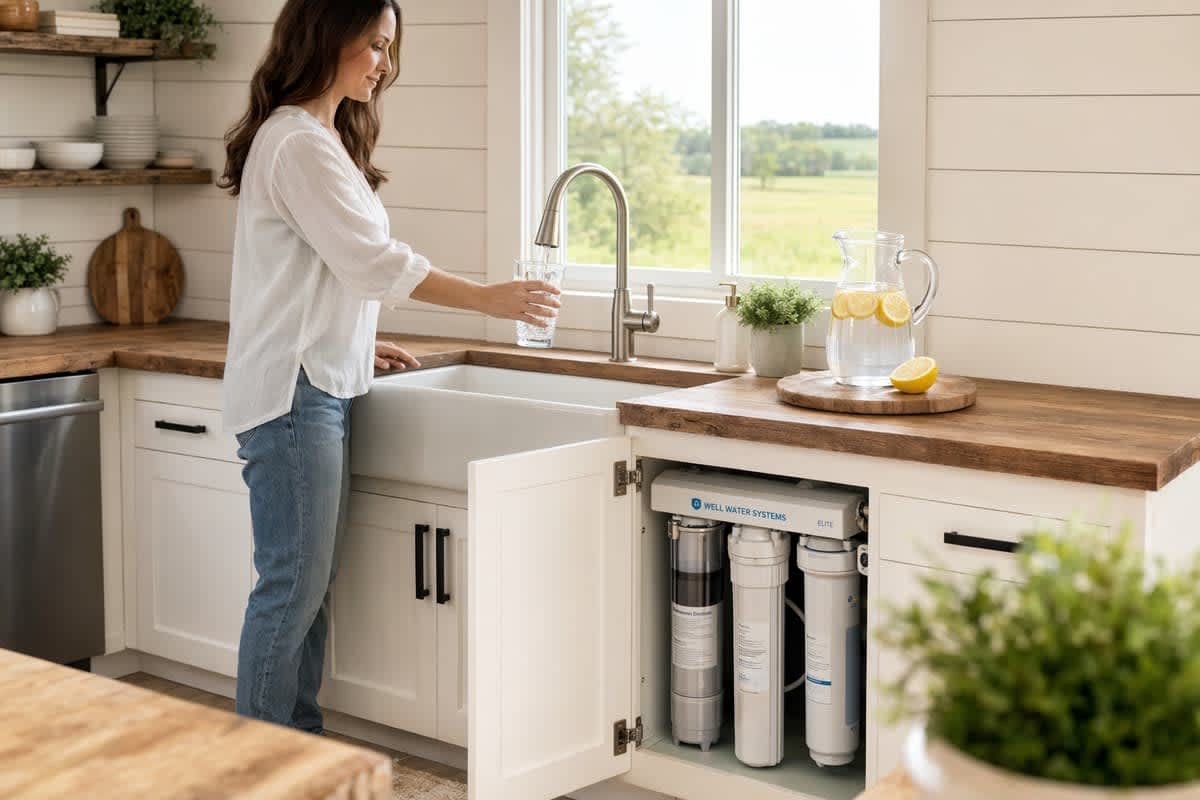
How much does a well water filtration system cost?
How much does a well water filtration system cost?
$800 – $5,000 average total cost
$1,000 – $3,500 per iron/manganese filter
$3,000 – $10,000 per multi-stage system

Average well water filtration system cost
A well water filtration system costs $1,500 to $5,000 on average, including equipment and professional installation. Homeowners can spend as little as $300 for a basic sediment filter or upward of $10,000+ for a multi-stage whole-house system that addresses iron, manganese, bacteria, and other common well water contaminants. The final price depends on water quality issues, system type, home size, and installation complexity.
Unlike municipal water, well water is unregulated by the EPA, meaning homeowners are responsible for treating their own supply. Investing in the right filtration system protects your family's health, extends the life of plumbing and appliances, and eliminates issues like rotten-egg odor, staining, and hard water buildup.
| System type | Equipment cost | Installed cost |
|---|---|---|
| Sediment filter | $50 – $300 | $150 – $500 |
| Carbon filtration (whole-house) | $300 – $1,000 | $600 – $2,000 |
| Iron/manganese filter | $500 – $2,500 | $1,000 – $3,500 |
| Water softener | $500 – $2,500 | $1,000 – $3,500 |
| UV disinfection system | $400 – $1,500 | $700 – $2,500 |
| Reverse osmosis (point-of-use) | $200 – $600 | $300 – $1,000 |
| Reverse osmosis (whole-house) | $2,000 – $5,000 | $4,000 – $10,000 |
| Multi-stage whole-house system | $1,500 – $5,000 | $2,500 – $10,000+ |
Cost by system type
Well water filtration systems vary widely in design, capability, and price. The right system for your home depends entirely on what contaminants your water testing reveals. Many well owners need more than one type of filtration working together to achieve clean, safe water throughout the house.
Sediment filters
Sediment filters cost $50 to $300 for equipment and $150 to $500 installed. These are the most basic and least expensive filtration option. They remove sand, silt, rust particles, and other debris from well water using pleated or spun polypropylene cartridges.
Most well water systems include a sediment filter as the first stage. It protects downstream equipment like water softeners, UV lights, and carbon filters from clogging. Replacement cartridges cost $5 to $30 each and need changing every one to three months depending on sediment levels.
Carbon filtration systems
Whole-house carbon filtration systems cost $300 to $1,000 for equipment, or $600 to $2,000 installed. These systems use activated carbon (granular or catalytic) to remove chlorine, pesticides, herbicides, volatile organic compounds (VOCs), and unpleasant tastes and odors.
For well water specifically, catalytic carbon filters are popular because they also help reduce hydrogen sulfide, the compound responsible for rotten-egg smell. Carbon tank systems with backwashing capability last longer between media changes (typically three to five years) compared to cartridge-style carbon filters that need replacement every six to twelve months.
Iron and manganese filters
Iron and manganese removal systems cost $500 to $2,500 for the unit and $1,000 to $3,500 fully installed. These are among the most common systems for well water because iron and manganese are prevalent in groundwater across much of the country.
| Iron filter type | Equipment cost | Best for |
|---|---|---|
| Birm filter | $400 – $1,200 | Low to moderate iron (under 3 ppm), pH above 6.8 |
| Greensand filter | $600 – $1,800 | Iron, manganese, and hydrogen sulfide |
| Air injection/oxidation filter | $800 – $2,500 | High iron (up to 10+ ppm), chemical-free treatment |
| Chemical feed pump + filter | $500 – $2,000 | Very high iron, bacteria, hydrogen sulfide |
Iron stains fixtures, laundry, and toilets orange or brown, while manganese causes black staining. Even at levels as low as 0.3 ppm for iron, these contaminants create noticeable problems. Air injection systems are a popular chemical-free option that oxidizes iron and manganese so they can be filtered out during the backwash cycle.
Water softeners
Water softeners for well water cost $500 to $2,500 for equipment and $1,000 to $3,500 installed. Hard water is extremely common in wells, with mineral content often exceeding 15 grains per gallon (gpg) in many regions.
Ion-exchange water softeners remove calcium, magnesium, and some dissolved iron by exchanging them for sodium or potassium ions. Operating costs include $5 to $15 per month for salt. Well water softeners often need to be sized larger than those for city water because hardness levels tend to be higher.
If your well water has more than 1 to 2 ppm of iron, install a dedicated iron filter before the water softener. Excess iron fouls softener resin, reducing its effectiveness and lifespan. The proper treatment sequence is: sediment filter, iron filter, water softener, then any point-of-use systems.
UV disinfection systems
UV disinfection systems cost $400 to $1,500 for equipment and $700 to $2,500 installed. These systems use ultraviolet light to kill 99.99% of bacteria, viruses, E. coli, coliform, Giardia, and Cryptosporidium without adding chemicals to the water.
UV systems are essential for wells that test positive for bacterial contamination. They require clear, sediment-free water to work effectively, so a sediment filter and potentially an iron filter should be installed upstream. The UV lamp needs annual replacement at a cost of $50 to $150, and the quartz sleeve should be cleaned or replaced periodically.
Reverse osmosis systems
Point-of-use reverse osmosis (RO) systems cost $200 to $600 for the unit, while whole-house RO systems cost $2,000 to $5,000 for equipment alone. Installed costs for whole-house RO run $4,000 to $10,000.
RO systems push water through a semi-permeable membrane that removes up to 99% of dissolved solids, including arsenic, lead, nitrates, fluoride, and PFAS. For most well owners, a point-of-use RO system under the kitchen sink is the most cost-effective approach, providing purified drinking water without the expense and water waste of a whole-house unit.
Whole-house RO is typically reserved for wells with extreme contamination issues, such as high total dissolved solids (TDS) or nitrate levels that exceed safe limits throughout the home.
Cost by contaminant
The contaminants in your well water directly determine which filtration equipment you need and how much you'll spend. Some issues require a single system, while others demand a multi-stage approach. Below is a breakdown of what common well water problems cost to treat.
| Contaminant | Recommended system | Installed cost |
|---|---|---|
| Sediment/turbidity | Sediment filter | $150 – $500 |
| Iron (orange/brown stains) | Iron filter or oxidation system | $1,000 – $3,500 |
| Manganese (black stains) | Greensand or oxidation filter | $1,000 – $3,000 |
| Hydrogen sulfide (rotten-egg smell) | Air injection filter or carbon filter | $800 – $3,500 |
| Hard water (scale buildup) | Water softener | $1,000 – $3,500 |
| Bacteria/E. coli/coliform | UV disinfection | $700 – $2,500 |
| Nitrates | Reverse osmosis or anion exchange | $300 – $5,000 |
| Arsenic | Arsenic-specific media or RO | $1,000 – $4,000 |
| Lead | Reverse osmosis or carbon block | $300 – $2,000 |
| PFAS ("forever chemicals") | Activated carbon or RO | $500 – $4,000 |
| Low pH/acidic water | Acid neutralizer (calcite tank) | $800 – $2,500 |
| Tannins (yellow/brown color) | Tannin filter (anion exchange) | $1,000 – $3,000 |
Many well owners deal with multiple contaminants simultaneously. A typical well water setup might include a sediment filter, iron removal system, water softener, and an under-sink RO system, with a combined installed cost of $3,000 to $7,000.
Installation costs
Professional installation adds $200 to $2,000 to the total project cost, depending on system complexity and local labor rates. A simple cartridge filter installation on an existing plumbing loop can take under an hour, while a multi-stage system with electrical connections, drain lines, and bypass valves may take a full day or more.
| Installation factor | Cost |
|---|---|
| Plumber labor rate | $75 – $150 per hour |
| Simple filter installation (1 to 2 hours) | $150 – $300 |
| Water softener installation | $200 – $500 |
| Multi-stage system installation | $500 – $2,000 |
| New plumbing loop or bypass | $200 – $500 |
| Electrical work (for UV, pumps) | $100 – $400 |
| Drain line installation | $100 – $300 |
Systems that require backwashing (iron filters, softeners, some carbon filters) need a drain connection, which adds cost if one isn't nearby. UV systems and chemical feed pumps require a dedicated electrical outlet. Plan for these additions when budgeting.
Some water treatment companies bundle installation into the equipment price, which can save 10% to 20% compared to buying equipment separately and hiring a plumber.
Factors that affect cost
Several variables influence how much you'll ultimately spend on well water filtration. Understanding these factors helps you budget accurately and avoid overspending on systems you don't need.
| Factor | Impact on cost |
|---|---|
| Number of contaminants | More contaminants = more stages = higher cost |
| Contaminant severity | Higher concentrations require larger or more advanced systems |
| Home size / water usage | Larger homes need higher-capacity (more expensive) systems |
| Flow rate requirements | Higher flow rates demand larger tanks and valves |
| Existing plumbing condition | Older or corroded plumbing increases installation time |
| Equipment brand and quality | Premium brands cost 30% to 50% more than budget options |
| Point-of-use vs. whole-house | Whole-house systems cost 3 to 10x more |
| Geographic location | Labor rates and permitting vary by region |
Home size and flow rate
Well water systems are sized based on the peak flow rate your household needs, measured in gallons per minute (GPM). A two-bathroom home typically needs 7 to 10 GPM, while a four-bathroom home may require 12 to 15 GPM or more.
Larger systems use bigger tanks and higher-capacity control valves, which cost more. Upgrading from a standard 10-inch diameter tank to a 13-inch tank can add $200 to $500 per system.
Equipment quality and brand
Budget-friendly systems from online retailers cost $300 to $1,500, while premium, American-made units from brands like Clack, Fleck, and Stenner range from $1,000 to $4,000+ per system. The difference often shows up in valve quality, media longevity, and warranty coverage.
Look for systems with NSF/ANSI certifications (Standard 42, 44, 53, or 58) to ensure the equipment actually performs as advertised. Cheaper, uncertified systems may underperform or fail sooner.
Ongoing maintenance costs
Well water filtration systems require regular maintenance to perform properly. Annual maintenance costs average $100 to $500, depending on the type and number of systems installed. Neglecting maintenance leads to reduced filtration performance, bacterial growth, and premature equipment failure.
| Maintenance task | Frequency | Cost |
|---|---|---|
| Sediment filter cartridge replacement | Every 1 to 3 months | $5 – $30 each |
| Carbon filter cartridge replacement | Every 6 to 12 months | $20 – $80 each |
| Carbon media replacement (tank system) | Every 3 to 5 years | $150 – $400 |
| Iron filter media replacement | Every 5 to 10 years | $200 – $600 |
| Water softener salt | Monthly | $5 – $15 per month |
| Water softener resin replacement | Every 10 to 15 years | $200 – $500 |
| UV lamp replacement | Annually | $50 – $150 |
| UV quartz sleeve replacement | Every 2 to 3 years | $30 – $80 |
| RO membrane replacement | Every 2 to 3 years | $50 – $200 |
| RO pre/post filters | Every 6 to 12 months | $30 – $60 |
| Chemical feed solution (chlorine/peroxide) | Monthly | $10 – $30 per month |
| Annual water testing | Annually | $25 – $500 |
Over a 10-year span, expect to spend $1,000 to $5,000 on total maintenance, depending on system complexity. Budget for annual water testing as well to confirm your systems are still performing as expected. If your system needs water filtration system repairs, expect to pay $100 to $500 depending on the issue and system type.
Well water quality can change over time due to seasonal fluctuations, nearby agricultural activity, septic system issues, or changes in the water table. Annual testing ensures your filtration system is still addressing the right contaminants at the right levels.
DIY vs. professional installation
DIY installation saves $200 to $2,000 in labor costs, but it's not always the right choice. Simple systems like under-sink RO filters and basic sediment cartridge housings are manageable for handy homeowners. Complex multi-stage systems with backwashing valves, chemical injection, and electrical connections are best left to professionals.
| Approach | Pros | Cons |
|---|---|---|
| DIY installation | Saves $200 – $2,000 in labor; flexible scheduling | Risk of improper sizing; may void warranty; no expert water analysis |
| Professional installation | Correct sizing; warranty coverage; proper treatment sequence; expert water analysis | Higher upfront cost; scheduling required |
Systems suitable for DIY
- Under-sink reverse osmosis systems
- Cartridge-style sediment and carbon filter housings
- Countertop water filters
- Simple UV add-ons to existing filter loops
Systems that benefit from professional installation
- Whole-house iron/manganese filters with backwashing valves
- Water softeners (sizing and programming are critical)
- Chemical feed pump systems (chlorine or hydrogen peroxide injection)
- Multi-stage treatment trains
- Whole-house reverse osmosis systems
A water treatment professional also provides proper system sizing based on your water test results, flow rate requirements, and household size. Incorrect sizing is the most common mistake in DIY installations and leads to poor filtration, low water pressure, or premature media exhaustion.
Water testing before buying a system
Water testing is the essential first step before purchasing any filtration equipment. A comprehensive well water test costs $100 to $500, depending on the number of parameters tested. Basic tests for bacteria and nitrates cost as little as $25 to $50 through local health departments.
| Test type | Parameters covered | Cost |
|---|---|---|
| Basic (health department) | Bacteria, nitrates | $25 – $50 |
| Standard panel | Bacteria, nitrates, pH, hardness, iron, manganese, TDS | $100 – $200 |
| Comprehensive panel | All standard plus arsenic, lead, copper, fluoride, sulfate, VOCs | $200 – $400 |
| Full contaminant scan | All comprehensive plus PFAS, pesticides, radon, radionuclides | $300 – $500+ |
Never buy a well water system based on guesswork or general recommendations. Every well is different, and a system that works for your neighbor's well may not address your specific water quality issues. A lab-certified water test provides the data needed to select the correct equipment and avoid wasting money on unnecessary filtration.
Many water treatment companies offer free or discounted water testing when you purchase a system through them. Be cautious with free tests from companies that only sell one brand, as they may recommend equipment you don't actually need.
Frequently asked questions
Is a well water filtration system worth the investment?
Yes. Untreated well water can contain bacteria, heavy metals, nitrates, and other contaminants that pose health risks. Even non-health-related issues like hard water and iron cause hundreds of dollars in damage annually to plumbing, appliances, and fixtures. A properly sized filtration system typically pays for itself within three to five years through reduced plumbing repairs, longer appliance life, and elimination of bottled water purchases.
How long do well water filtration systems last?
Most well water filtration systems last 10 to 20 years with proper maintenance. Tanks and housings are the longest-lasting components, while media, membranes, and control valves may need replacement every 5 to 15 years. UV lamps require annual replacement, and filter cartridges need changing every few months.
What is the best filtration system for well water?
There is no single "best" system because every well has different water quality issues. The best approach is to test your water first, then build a treatment train that addresses your specific contaminants. A common and effective setup for well water includes a sediment pre-filter, iron/manganese oxidation filter, water softener, and an under-sink RO system for drinking water.
Do I need a whole-house system or a point-of-use system?
It depends on the contaminant. Issues like iron, hardness, sediment, and hydrogen sulfide affect the entire home and require whole-house water filtration. Health-related contaminants like arsenic, nitrates, and lead can often be addressed with a less expensive point-of-use RO system at the kitchen sink, where drinking water is drawn.
Can I combine multiple systems?
Yes, and most well water applications require it. Systems are installed in a specific sequence to work properly. The typical order is: sediment filter first, then acid neutralizer (if needed), then iron filter, then water softener, then UV disinfection, with a point-of-use RO system at the kitchen tap. Each system protects the one downstream from it.
Will a filtration system reduce my water pressure?
Some pressure drop is normal, typically 2 to 10 PSI per system. Properly sized systems minimize this impact. If you're installing multiple systems, make sure your well pump and pressure tank can handle the additional load. A constant pressure system or larger pressure tank may be needed, adding $500 to $2,000 to the overall project cost.