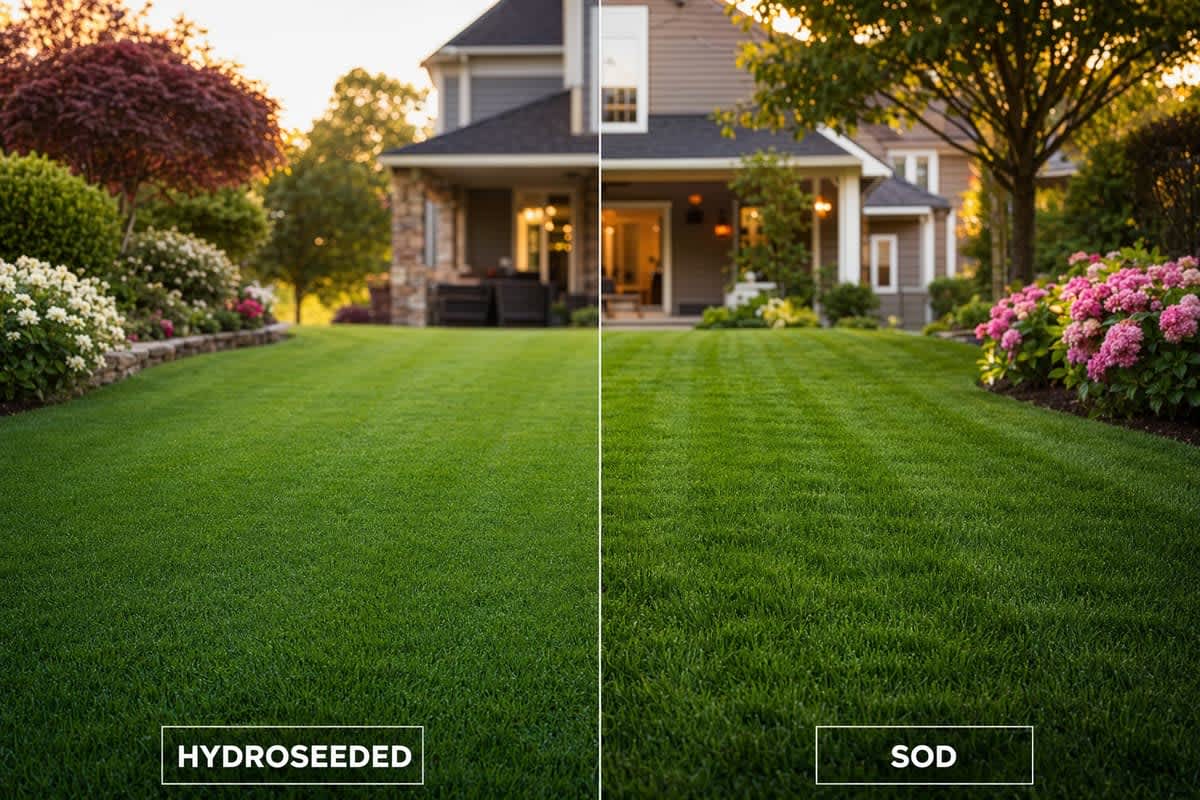
How much does hydroseeding cost vs. sod?
How much does hydroseeding cost vs. sod?
$0.06 – $0.20 per square foot (hydroseeding)
$0.87 – $1.76 per square foot (sod installed)
$500 – $1,000 per 5,000 sq. ft. lawn (hydroseeding)

Hydroseeding cost vs. sod: a side-by-side comparison
Hydroseeding costs $0.06 to $0.20 per square foot, while sod installation runs $0.87 to $1.76 per square foot. For a typical 5,000-square-foot lawn, that means you'll pay roughly $500 to $1,000 for hydroseeding compared to $4,350 to $8,800 for sod. Hydroseeding is consistently 50% to 80% cheaper than sod, making it the clear budget winner, but sod delivers an instant, usable lawn.
Choosing between hydroseeding and sod is one of the most common decisions homeowners face when establishing a new lawn. Each method has distinct advantages in terms of cost, timeline, durability, and long-term results. This guide breaks down every cost detail so you can make an informed decision.
| Method | Cost per sq. ft. | 5,000 sq. ft. lawn | 10,000 sq. ft. lawn |
|---|---|---|---|
| Hydroseeding | $0.06 – $0.20 | $500 – $1,000 | $1,000 – $2,000 |
| Sod installation | $0.87 – $1.76 | $4,350 – $8,800 | $8,700 – $17,600 |
| Traditional seeding (for reference) | $0.04 – $0.16 | $200 – $800 | $400 – $1,600 |
How much does hydroseeding cost?
Professional hydroseeding costs $0.06 to $0.20 per square foot on average, with most homeowners paying around $0.10 per square foot. The total cost for a residential lawn typically falls between $500 and $3,000, depending on yard size, seed mix, and site preparation needs.
| Lawn size | Average hydroseeding cost |
|---|---|
| 1,000 sq. ft. | $100 – $200 |
| 2,500 sq. ft. | $250 – $500 |
| 5,000 sq. ft. | $500 – $1,000 |
| 10,000 sq. ft. | $1,000 – $2,000 |
| 1 acre (43,560 sq. ft.) | $2,500 – $5,000 |
Hydroseeding involves spraying a slurry of grass seed, mulch, fertilizer, and water onto prepared soil using a specialized machine. The mulch layer helps retain moisture, encourages germination, and prevents erosion, making this method especially effective on slopes and large properties.
What's included in hydroseeding costs
A professional hydroseeding quote typically covers the seed mix, tackifier (binding agent), mulch, starter fertilizer, water, labor, and equipment. Some contractors include basic soil grading in their price, while others charge separately for site preparation.
| Component | Cost contribution |
|---|---|
| Grass seed mix | $0.01 – $0.05 per sq. ft. |
| Wood fiber or paper mulch | $0.01 – $0.04 per sq. ft. |
| Fertilizer and tackifier | $0.01 – $0.03 per sq. ft. |
| Labor and equipment | $0.03 – $0.08 per sq. ft. |
| Soil preparation (if needed) | $0.02 – $0.10 per sq. ft. |
Most hydroseeding companies have a minimum job charge of $300 to $500 regardless of lawn size. This covers mobilization of the truck-mounted equipment. Smaller yards may not see the best per-square-foot rates because of this minimum.
How much does sod cost?
Sod installation costs $0.87 to $1.76 per square foot including materials and labor. The sod itself runs $0.30 to $0.85 per square foot, while professional installation labor adds another $0.57 to $0.91 per square foot. A typical 5,000-square-foot lawn costs $4,350 to $8,800 fully installed.
| Lawn size | Sod material only | Installed cost (materials + labor) |
|---|---|---|
| 1,000 sq. ft. | $300 – $850 | $870 – $1,760 |
| 2,500 sq. ft. | $750 – $2,125 | $2,175 – $4,400 |
| 5,000 sq. ft. | $1,500 – $4,250 | $4,350 – $8,800 |
| 10,000 sq. ft. | $3,000 – $8,500 | $8,700 – $17,600 |
| 1 acre (43,560 sq. ft.) | $13,000 – $37,000 | $38,000 – $76,700 |
Sod prices by grass type
The grass variety you choose significantly impacts the price of sod. Premium warm-season grasses like Bermuda and Zoysia cost more than common cool-season blends. Here's how popular sod types compare.
| Grass type | Cost per sq. ft. (material only) | Climate |
|---|---|---|
| Kentucky bluegrass | $0.30 – $0.60 | Cool season |
| Tall fescue | $0.30 – $0.55 | Cool season / transition zone |
| Bermuda grass | $0.35 – $0.65 | Warm season |
| Zoysia grass | $0.40 – $0.75 | Warm season |
| St. Augustine | $0.35 – $0.70 | Warm season |
| Centipede grass | $0.30 – $0.55 | Warm season |
Sod installation labor costs
Professional sod installation labor costs $0.57 to $0.91 per square foot, or roughly $3 to $6 per roll (each roll covers about 10 square feet). Labor includes unloading pallets, cutting pieces to fit edges and landscaping features, laying the sod in a staggered brick pattern, and initial rolling to ensure soil contact.
Site preparation is often charged separately at $1 to $2 per square foot. This covers removing old grass, tilling, amending soil, grading, and leveling. If your yard needs extensive grading work, expect to add $1,000 to $3,000 to the total project cost.
Factors that affect cost
Several variables influence whether your project lands at the low or high end of these price ranges. Understanding these factors helps you budget accurately and identify areas where you can save.
| Factor | Impact on hydroseeding | Impact on sod |
|---|---|---|
| Lawn size | Larger lawns get lower per-sq.-ft. rates | Bulk sod orders may qualify for discounts |
| Soil preparation | Adds $0.02 – $0.10 per sq. ft. | Adds $1 – $2 per sq. ft. |
| Slope or terrain | Minimal added cost; excels on slopes | Adds 10% – 25% for staking and extra labor |
| Seed or grass variety | Premium mixes add $0.02 – $0.05 per sq. ft. | Premium sod adds $0.10 – $0.30 per sq. ft. |
| Geographic region | Higher in coastal and urban areas | Higher in areas far from sod farms |
| Season/timing | Spring and fall are peak pricing seasons | Summer installations may require more watering |
| Accessibility | Hose reach from truck is a factor | Tight access adds labor for hand-carrying pallets |
Lawn size and economies of scale
Both hydroseeding and sod become cheaper per square foot as the project size increases. Hydroseeding benefits from economies of scale more dramatically because the equipment setup cost stays the same whether you're covering 2,000 or 20,000 square feet.
Sod pricing also drops with larger orders since you can negotiate pallet pricing. A single pallet covers roughly 450 to 500 square feet and costs $150 to $450 depending on grass type.
Soil preparation
Proper soil preparation is critical for both methods. For hydroseeding, the soil should be loosened, graded, and free of debris. For sod, the surface needs to be smooth, level, and slightly moistened before laying.
If your existing lawn needs removal, expect to pay $1 to $2 per square foot for sod removal, or $150 to $400 for a sod cutter rental if you do it yourself. Soil testing costs $15 to $50 and is recommended for both methods to determine whether amendments like lime or compost are needed.
Geographic location
Regional pricing varies significantly. Hydroseeding in the Pacific Northwest or Southeast typically costs less than in the Northeast or Mountain West due to contractor availability and growing conditions. Sod prices are lowest near major sod farms in the South and Midwest, where transportation costs are minimal.
Pros and cons of each method
Cost is important, but it's not the only consideration. Each method has strengths and weaknesses that may outweigh the price difference depending on your situation.
| Category | Hydroseeding | Sod |
|---|---|---|
| Cost | ✅ 50% – 80% cheaper | ❌ Significantly more expensive |
| Instant results | ❌ Takes 2 – 3 weeks to germinate | ✅ Immediate green lawn |
| Full establishment | 6 – 8 weeks for full coverage | 2 – 3 weeks to root |
| Usable lawn | 8 – 12 weeks before foot traffic | 2 – 4 weeks before regular use |
| Erosion control | ✅ Excellent; mulch binds to slopes | ✅ Good; immediate ground cover |
| Slope performance | ✅ Ideal for steep or uneven terrain | ❌ Difficult to install; may slide |
| Seed variety options | ✅ Wide selection; custom blends available | ❌ Limited to locally grown varieties |
| Drought tolerance (initial) | ❌ Requires frequent watering | ❌ Also requires frequent watering |
| Large area coverage | ✅ Fast and cost-effective | ❌ Labor-intensive and expensive |
| Weed susceptibility | ❌ More vulnerable during establishment | ✅ Dense turf resists weeds early |
| DIY feasibility | ❌ Requires specialized equipment | ✅ Can be done by homeowners |
Hydroseeding advantages
Hydroseeding's biggest advantage is cost savings, especially on large properties. It also provides superior erosion control on slopes because the mulch and tackifier bind the slurry directly to the soil surface. Additionally, you can choose custom seed blends tailored to your specific soil type, shade conditions, and climate.
The root system developed from hydroseeding tends to be deeper and stronger than sod because the grass grows in place from seed. This often produces a healthier, more resilient lawn over the long term.
Hydroseeding drawbacks
The primary downside is time. You'll wait 2 to 3 weeks for germination and 6 to 8 weeks for a fully established lawn. During this period, the area must be watered frequently (often 2 to 3 times daily) and cannot handle foot traffic.
Hydroseeded lawns are also more susceptible to weed invasion, washout from heavy rain, and bird feeding during the germination phase. Patchy results can occur if application is uneven or watering is inconsistent.
Sod advantages
Sod delivers an instant, mature lawn. You can walk on it within 2 to 4 weeks and mow it within 2 to 3 weeks. It provides immediate erosion control, curb appeal, and property value. For homeowners selling a home or hosting an event, sod is the only way to get a green lawn quickly.
Sod also resists weeds much better during establishment because the dense turf leaves no bare soil for weed seeds to colonize.
Sod drawbacks
Sod is expensive, especially for larger properties. The grass variety options are limited to what local sod farms grow, which may not be ideal for your specific yard conditions. Sod can also struggle on steep slopes because the rolls may shift before roots establish.
Another concern is timing: sod must be installed within 24 to 48 hours of harvest, or it will begin to deteriorate. This creates scheduling pressure and limits flexibility around your installation date.
Which option is best for your lawn?
The right choice depends on your budget, timeline, property size, and terrain. Here's a quick guide to help you decide.
| Scenario | Best option | Why |
|---|---|---|
| Tight budget | Hydroseeding | Costs 50% – 80% less than sod |
| Need instant lawn | Sod | Green and usable within weeks |
| Large property (1+ acre) | Hydroseeding | Dramatically cheaper at scale |
| Steep slopes | Hydroseeding | Adheres to slopes; sod may slide |
| Small front yard | Sod | Immediate curb appeal; manageable cost |
| Selling your home | Sod | Instant results for showings |
| New construction | Hydroseeding | Cost-effective for large, graded lots |
| Erosion-prone areas | Hydroseeding | Mulch and tackifier hold soil in place |
| Specific grass blend needed | Hydroseeding | Custom seed mixes available |
| High-traffic yard | Sod | Faster establishment means quicker use |
Some homeowners hydroseed the backyard and large areas while sodding the front yard for instant curb appeal. This combination can save 30% to 50% compared to sodding the entire property while still creating a great first impression.
DIY vs. professional installation
DIY sod installation can save $0.57 to $0.91 per square foot in labor costs. DIY hydroseeding is more challenging because it requires renting or buying a hydroseeder, which limits practical savings.
| Approach | Cost for 5,000 sq. ft. | Savings vs. professional |
|---|---|---|
| DIY sod (materials only) | $1,500 – $4,250 | $2,850 – $4,550 |
| Professional sod | $4,350 – $8,800 | Baseline |
| DIY hydroseeding (rental unit) | $400 – $800 | $100 – $200 |
| Professional hydroseeding | $500 – $1,000 | Baseline |
DIY sod installation
Laying sod yourself is physically demanding but straightforward. You'll need to prepare the soil, order sod for delivery (typically $50 to $150 for delivery), and install it within 24 hours. Plan on a full day of work for 1,000 square feet with one or two helpers.
Tools you'll need include a sod cutter or flat shovel, rake, roller, garden hose, and a sharp knife for cutting. Most of these can be rented for $40 to $75 per day.
DIY hydroseeding
Renting a hydroseeder costs $150 to $350 per day, plus you'll need to purchase seed, mulch, fertilizer, and tackifier separately. Small handheld or towable units are available at some equipment rental companies and cover 1,000 to 5,000 square feet per tank load.
The savings for DIY hydroseeding are modest compared to professional service because the equipment rental and material costs eat into the margin. Most homeowners find that professional hydroseeding is the better value unless they plan to hydroseed multiple areas over time.
Frequently asked questions
Is hydroseeding cheaper than sod?
Yes. Hydroseeding costs $0.06 to $0.20 per square foot compared to $0.87 to $1.76 per square foot for sod. On a 5,000-square-foot lawn, hydroseeding saves $3,000 to $8,000 over sod installation.
How long does hydroseeding take to grow?
Hydroseeded grass typically germinates within 7 to 14 days and reaches mowing height in 4 to 6 weeks. Full establishment with dense coverage takes 6 to 8 weeks under optimal conditions with consistent watering.
Is hydroseeding better than sod long-term?
Hydroseeded lawns often develop deeper, stronger root systems because the grass grows in its native soil from the start. Sod can develop shallow roots if not properly maintained during establishment. Both methods produce healthy lawns when properly cared for; the long-term quality depends more on maintenance than installation method.
When is the best time to hydroseed?
The best time to hydroseed is early fall (September to October) for cool-season grasses and late spring (April to June) for warm-season grasses. These windows provide optimal soil temperatures for germination and establishment before extreme heat or cold arrives.
How often should I water hydroseeding?
Water hydroseeded areas 2 to 3 times daily with light applications for the first 2 to 3 weeks. The goal is to keep the mulch layer consistently moist without creating puddles or runoff. After germination, gradually transition to deeper, less frequent watering to encourage root growth.
How soon can you walk on hydroseeded grass?
Avoid walking on hydroseeded areas for at least 6 to 8 weeks after application. The young grass is fragile, and foot traffic can damage developing roots and create bare patches. Light foot traffic is generally safe after 8 to 12 weeks, once the lawn is fully established.
Does hydroseeding require reseeding?
Some hydroseeded lawns may need spot reseeding in areas where germination was uneven or where washout occurred. Professional contractors often include one follow-up visit in their pricing to address bare spots. Overall, a properly applied and maintained hydroseed application should not require full reseeding.