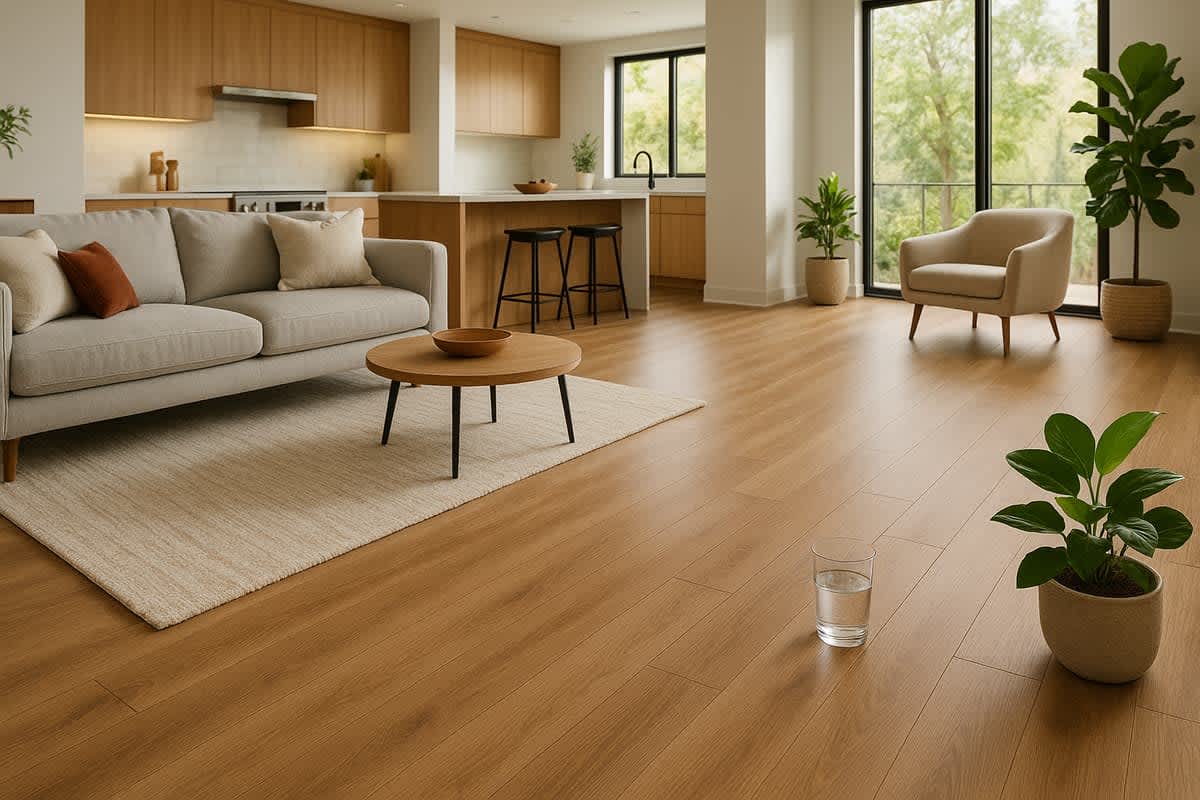
What is the best waterproof flooring?
What is the best waterproof flooring?
$0.89 – $12.00 per square foot
$1.50 – $7.00 per square foot (LVP)
$3.00 – $10.00 per square foot (porcelain tile)

Top waterproof flooring options for every room
Waterproof flooring has become one of the most sought-after home improvement materials, and for good reason. It protects against moisture damage, holds up in high-traffic areas, and works in every room from basements to bathrooms. Whether you're dealing with spill-prone kitchens, humid basements, or busy entryways, the right waterproof flooring eliminates worry about water damage while delivering the look you want.
The best waterproof flooring types include luxury vinyl plank (LVP), porcelain tile, waterproof laminate, and natural stone. Prices range from $0.89 to $12 per square foot for materials, depending on the type, brand, and quality tier you choose. Each option has distinct advantages depending on your budget, style preferences, and the specific demands of the room.
| Flooring type | Waterproof level | Average cost per sq. ft. | Best for |
|---|---|---|---|
| Luxury vinyl plank (LVP) | Fully waterproof | $1.50 - $7.00 | Kitchens, bathrooms, basements |
| Porcelain tile | Fully waterproof | $3.00 - $10.00 | Bathrooms, laundry rooms, entryways |
| Ceramic tile | Highly water-resistant | $0.98 - $8.00 | Bathrooms, kitchens |
| Waterproof laminate | Waterproof (core only) | $2.00 - $6.00 | Living rooms, bedrooms, kitchens |
| Sheet vinyl | Fully waterproof | $0.50 - $4.00 | Bathrooms, laundry rooms, basements |
| Natural stone | Water-resistant (requires sealing) | $5.00 - $15.00 | Bathrooms, entryways, outdoor areas |
| Epoxy flooring | Fully waterproof | $3.00 - $12.00 | Basements, garages, utility rooms |
Luxury vinyl plank (LVP): the most popular waterproof flooring
Luxury vinyl plank is the top choice for waterproof flooring in most homes. It combines a fully waterproof core, realistic wood-grain visuals, comfortable underfoot feel, and easy installation at a price point that fits most budgets. LVP costs $1.50 to $7.00 per square foot for materials, making it one of the most accessible waterproof options available.
Within the LVP category, you'll find several construction types that differ in core material, thickness, and price. Understanding these distinctions helps you choose the right product for your specific needs.
| LVP construction type | Core material | Typical thickness | Cost per sq. ft. |
|---|---|---|---|
| SPC (stone polymer composite) | Limestone and PVC | 4 mm - 8 mm | $2.50 - $7.00 |
| WPC (wood polymer composite) | Wood flour and PVC | 5 mm - 8 mm | $2.00 - $6.50 |
| Rigid core vinyl | Varies | 3.2 mm - 8 mm | $1.19 - $5.00 |
| Glue-down LVP | Flexible PVC | 2.5 mm - 3 mm | $0.89 - $3.00 |
SPC vs. WPC: which rigid core is better?
SPC (stone polymer composite) floors have a denser, more rigid core made from limestone and PVC. They resist dents and impacts better than WPC, making them ideal for commercial spaces and high-traffic residential areas. SPC planks are typically thinner but harder underfoot.
WPC (wood polymer composite) floors use a foamed core that provides more cushion and sound absorption. They feel warmer and more comfortable to walk on, which makes them a better choice for bedrooms, living rooms, and spaces where you stand for long periods. WPC is slightly more susceptible to denting from heavy furniture.
Both SPC and WPC are 100% waterproof at the core level. The critical difference lies in comfort versus durability. If your priority is toughness in a busy kitchen, choose SPC. If you want a softer feel in a family room, go with WPC.
LVP thickness and wear layers explained
Thickness matters, but the wear layer is what determines how long your floor lasts. The wear layer is the transparent top coating that protects against scratches, stains, and fading. For residential use, a wear layer of 12 mils to 20 mils is standard. For high-traffic areas or homes with pets, look for 20 mils or more.
Overall plank thickness (including the core and any attached padding) ranges from 3 mm to 8 mm. Thicker planks generally feel more substantial underfoot and do a better job masking minor subfloor imperfections. Budget-friendly options at 3.2 mm can cost as little as $1.19 per square foot, while premium 7 mm to 8 mm planks with attached underlayment run $3.27 to $4.26 per square foot or more.
Many waterproof vinyl planks come with a pre-attached cork or foam pad. This simplifies installation and improves sound dampening. If your LVP doesn't include an attached pad, purchase a compatible underlayment separately, typically costing $0.25 to $0.75 per square foot. Never use a standard foam underlayment designed for laminate; it can cause vinyl planks to shift and unlock.
Best brands for waterproof luxury vinyl plank
Several brands consistently receive high marks from homeowners and industry professionals. The best LVP brands balance realistic visuals, strong wear layers, solid warranties, and competitive pricing.
| Brand | Notable product line | Key features | Price per sq. ft. |
|---|---|---|---|
| CoreLuxe (Lumber Liquidators) | CoreLuxe Rigid Vinyl | Wide range of thicknesses, attached pad options | $1.19 - $4.26 |
| LifeProof (Home Depot) | LifeProof Rigid Core | Scratch-resistant, pre-attached underlayment | $2.50 - $4.00 |
| COREtec | COREtec Plus | Patented cork-backed core, premium feel | $3.50 - $7.00 |
| Shaw Floorté | Floorté Pro | Commercial-grade wear layers, wide planks | $3.00 - $6.00 |
| Mohawk RevWood | RevWood Premier | Wood-like texture, excellent scratch resistance | $2.50 - $5.00 |
| MSI Everlife | Cyrus, Prescott series | SPC core, CrystaLux wear layer | $2.00 - $4.50 |
Porcelain and ceramic tile
Porcelain tile is one of the most durable waterproof flooring materials available. It absorbs less than 0.5% moisture, making it virtually impervious to water. Ceramic tile is also highly water-resistant, though it has a slightly higher absorption rate and requires proper sealing in wet areas. Expect to pay $0.98 to $10.00 per square foot for materials.
| Feature | Porcelain tile | Ceramic tile |
|---|---|---|
| Water absorption rate | Less than 0.5% | 0.5% - 3% |
| Material cost per sq. ft. | $3.00 - $10.00 | $0.98 - $8.00 |
| Installation cost per sq. ft. | $5.00 - $15.00 | $4.00 - $12.00 |
| Durability | Excellent | Good |
| Feel underfoot | Hard, cold | Hard, cold |
| Best rooms | Bathrooms, entryways, laundry | Bathrooms, kitchens |
Why tile remains a top waterproof choice
Tile has been the default waterproof flooring for centuries, and modern manufacturing has only improved it. Today's porcelain tiles can mimic wood grain, marble, concrete, and dozens of other materials with photographic accuracy. Large-format tiles (24 x 24 inches and larger) minimize grout lines and create a seamless, modern look.
The main downside is comfort. Tile feels hard and cold underfoot unless you install radiant floor heating beneath it, which adds $6 to $16 per square foot to the project. Tile installation is also more labor-intensive and expensive than vinyl, often requiring professional work.
Grout matters for waterproofing
The tile itself is waterproof, but the grout between tiles is porous. Standard unsanded and sanded grout must be sealed regularly to prevent water from seeping through to the subfloor. For a truly waterproof tile installation, use epoxy grout. It costs more but provides a non-porous, stain-resistant seal that never needs resealing.
Waterproof laminate flooring
Traditional laminate flooring swells and warps when exposed to moisture. Waterproof laminate is a newer category that uses a moisture-resistant core, typically made from a dense composite material sealed to prevent water absorption. Prices range from $2.00 to $6.00 per square foot.
| Feature | Details |
|---|---|
| Material cost per sq. ft. | $2.00 - $6.00 |
| Installation cost per sq. ft. | $2.00 - $5.00 |
| Typical thickness | 8 mm - 12 mm |
| Waterproof duration (varies by brand) | 24 - 72 hours surface protection |
| Best for | Living rooms, bedrooms, hallways |
Is waterproof laminate truly waterproof?
Most waterproof laminate flooring products protect the core from moisture for a limited time, usually 24 to 72 hours. This is enough to handle spills, pet accidents, and everyday kitchen splashes. However, it is not designed for prolonged standing water or full submersion like you might encounter during a flood or from a broken pipe in a bathroom.
The seams between planks remain vulnerable. Water can work its way through click-lock joints over time if left standing. For bathrooms, laundry rooms, and basements where water exposure is frequent and potentially prolonged, LVP or tile is a safer bet. Waterproof laminate works best in living areas, bedrooms, and kitchens where spills are quickly cleaned up.
Some products labeled "water-resistant" only slow moisture absorption; they don't stop it. True waterproof flooring has a core that will not absorb water at all, even after extended exposure. Always check the manufacturer's warranty for specifics on how long the product can withstand surface water.
Sheet vinyl flooring
Sheet vinyl is one of the most affordable and effective waterproof flooring options. Because it comes in large, continuous rolls (typically 6 or 12 feet wide), it has fewer seams than plank or tile flooring. Fewer seams mean fewer places for water to penetrate, which gives sheet vinyl a natural advantage in moisture-heavy rooms. Costs range from $0.50 to $4.00 per square foot for materials.
| Feature | Details |
|---|---|
| Material cost per sq. ft. | $0.50 - $4.00 |
| Installation cost per sq. ft. | $1.00 - $3.00 |
| Seam risk | Very low (large continuous rolls) |
| Design options | Moderate (wood, stone, abstract patterns) |
| Durability | Moderate (prone to punctures and tears) |
| Best for | Basements, bathrooms, laundry rooms, rentals |
Sheet vinyl lacks the premium look and feel of LVP or tile, but it excels in budget renovations and rental properties. Modern sheet vinyl has come a long way in terms of design realism, with textured options that simulate wood and stone. For basements prone to occasional moisture, sheet vinyl provides reliable protection at the lowest cost.
Natural stone and epoxy: premium waterproof options
For homeowners willing to invest more, natural stone and epoxy coatings offer high-end waterproof solutions with distinct aesthetics. Natural stone like slate, marble, and granite costs $5.00 to $15.00 per square foot for materials, while epoxy flooring runs $3.00 to $12.00 per square foot installed.
| Option | Waterproof? | Maintenance needs | Cost per sq. ft. |
|---|---|---|---|
| Marble | Water-resistant (requires sealing) | Annual sealing, careful cleaning | $8.00 - $15.00 |
| Slate | Water-resistant (requires sealing) | Annual sealing | $5.00 - $10.00 |
| Granite | Water-resistant (requires sealing) | Annual sealing | $6.00 - $12.00 |
| Epoxy coating | Fully waterproof | Minimal | $3.00 - $12.00 |
Natural stone considerations
Natural stone is not inherently waterproof. It is porous and must be sealed upon installation and resealed annually to prevent moisture absorption and staining. When properly maintained, stone floors can last a lifetime and add significant value to a home. The tradeoff is higher upfront cost, professional installation requirements, and ongoing maintenance.
Epoxy flooring for basements and garages
Epoxy creates a seamless, non-porous surface that is completely waterproof. It bonds directly to concrete and is commonly used in basements, garages, and commercial spaces. Modern epoxy systems can incorporate metallic pigments, flake blends, and decorative patterns that elevate the look well beyond the industrial appearance of older epoxy coatings.
Best waterproof flooring by room
Not every waterproof flooring type works equally well in every room. The level of moisture exposure, foot traffic, comfort needs, and visual expectations vary from space to space. Matching the right product to the right room ensures long-term performance and satisfaction.
| Room | Best waterproof flooring options | Why |
|---|---|---|
| Bathroom | Porcelain tile, LVP, sheet vinyl | Constant moisture, standing water risk |
| Kitchen | LVP (SPC), porcelain tile | Spills, heavy foot traffic |
| Basement | LVP, sheet vinyl, epoxy | Humidity, potential flooding |
| Laundry room | Porcelain tile, LVP, sheet vinyl | Machine leaks, water splashes |
| Entryway / mudroom | Porcelain tile, SPC vinyl | Tracked-in snow and rain, heavy traffic |
| Living room | WPC vinyl, waterproof laminate | Comfort, style, moderate spill risk |
| Bedroom | WPC vinyl, waterproof laminate | Comfort, quiet feel underfoot |
| Garage | Epoxy, porcelain tile | Chemical resistance, heavy loads |
Bathrooms
Bathrooms demand truly waterproof flooring that handles daily exposure to splashes, steam, and occasional pooling water. Porcelain tile with epoxy grout is the gold standard. LVP is a strong second choice because it's warmer underfoot and less expensive to install. Avoid waterproof laminate in full bathrooms, as the seams are too vulnerable to constant moisture. For more ideas on choosing the best flooring for your bathroom, consider how each material handles daily moisture exposure.
Basements
Basements face unique challenges: humidity from below-grade concrete slabs, potential flooding, and temperature fluctuations. LVP installed as a floating floor over a moisture barrier is the most popular basement solution. The floating installation allows the floor to be removed and replaced if a major water event occurs. Epoxy coating over the concrete slab is another excellent choice that eliminates the risk of trapped moisture. Explore additional basement flooring options to find the right fit for your space.
Kitchens
Kitchens need flooring that handles spills, dropped items, and heavy foot traffic. SPC luxury vinyl plank is the top pick because its rigid core resists dents from dropped cans and its surface handles spills without flinching. Porcelain tile is a close second, though it can crack if a heavy cast-iron pan falls on it. See our guide to the best flooring for kitchens for a deeper comparison of all kitchen-friendly materials.
Installation methods for waterproof flooring
How you install waterproof flooring affects its performance almost as much as the material itself. A poor installation can undermine even the best waterproof product. The three primary methods are click-lock floating, glue-down, and mortar-set (for tile).
| Installation method | Best for | DIY difficulty | Estimated labor cost per sq. ft. |
|---|---|---|---|
| Click-lock floating | LVP, waterproof laminate | Easy to moderate | $1.50 - $3.00 |
| Glue-down | Sheet vinyl, glue-down LVP | Moderate | $1.00 - $3.00 |
| Mortar-set (thin-set) | Porcelain tile, ceramic tile, stone | Difficult | $5.00 - $15.00 |
| Epoxy application | Concrete floors | Moderate to difficult | $3.00 - $7.00 |
Click-lock floating floors
Most LVP and waterproof laminate products use a click-lock system that snaps planks together without glue or nails. The floor "floats" over the subfloor with an expansion gap around the perimeter. This is the most DIY-friendly method and allows for quick installation, often covering an average room in a single day.
For maximum waterproofing on a floating floor, apply a bead of silicone sealant along the edges where the floor meets walls, cabinets, and transitions. Some installers also recommend a thin line of waterproof sealant in the click-lock joints in wet areas like bathrooms.
Glue-down installation
Glue-down LVP and sheet vinyl create a stronger bond with the subfloor, reducing the chance of water seeping underneath. This method is preferred in commercial settings and high-moisture residential areas. The tradeoff is that removal is more difficult and time-consuming if you ever want to replace the floor.
Key factors to consider when choosing waterproof flooring
Selecting the right waterproof flooring involves more than just water resistance. Several factors influence long-term satisfaction, performance, and total project cost.
| Factor | What to look for |
|---|---|
| Wear layer thickness | 12 mils minimum for residential; 20+ mils for pets and heavy traffic |
| Core type | SPC for durability; WPC for comfort |
| Warranty | Lifetime residential warranty preferred; check waterproof coverage specifics |
| Subfloor compatibility | Confirm product works over concrete, plywood, or existing floors |
| Underlayment | Attached pad saves money; separate pad offers customization |
| VOC emissions | Look for FloorScore or GreenGuard certification |
| Slip resistance | Textured or embossed surfaces improve safety in wet areas |
Warranty coverage for water damage
Not all "waterproof" warranties are created equal. Some manufacturers warrant the core against water damage but exclude damage caused by flooding, standing water beyond a certain time frame, or improper installation. Read the warranty document carefully. The best warranties cover water damage for the lifetime of the product with no time restrictions on surface water exposure.
Pet-friendly waterproof flooring
Homes with pets need waterproof flooring that resists scratches and stains in addition to moisture. SPC luxury vinyl plank with a 20-mil or thicker wear layer is the top recommendation. The rigid core won't dent from pet nails, and the thick wear layer prevents visible scratching. Avoid high-gloss finishes, which show scratches more easily. Instead, opt for matte, wire-brushed, or embossed textures. For a broader look at pet-safe materials, see our guide to the best flooring for dogs.
Indoor air quality and VOC concerns
Some vinyl flooring products emit volatile organic compounds (VOCs) that can affect indoor air quality. Choose products certified by FloorScore or GreenGuard Gold to ensure low emissions. These certifications indicate that the flooring has been independently tested and meets strict standards for chemical emissions. This is especially important in bedrooms, nurseries, and homes with allergy-sensitive occupants.
Waterproof flooring cost comparison: materials plus installation
Understanding the total cost of waterproof flooring, including both materials and professional installation, helps you budget accurately. The table below shows estimated all-in costs for a 500-square-foot project. For a complete breakdown of flooring installation costs across all material types, compare pricing before committing to a project.
| Flooring type | Material cost (500 sq. ft.) | Installation cost (500 sq. ft.) | Total estimated cost |
|---|---|---|---|
| Sheet vinyl | $250 - $2,000 | $500 - $1,500 | $750 - $3,500 |
| LVP (budget) | $595 - $1,500 | $750 - $1,500 | $1,345 - $3,000 |
| LVP (mid-range) | $1,500 - $2,500 | $750 - $1,500 | $2,250 - $4,000 |
| Waterproof laminate | $1,000 - $3,000 | $1,000 - $2,500 | $2,000 - $5,500 |
| LVP (premium) | $2,500 - $3,500 | $750 - $1,500 | $3,250 - $5,000 |
| Porcelain tile | $1,500 - $5,000 | $2,500 - $7,500 | $4,000 - $12,500 |
| Natural stone | $2,500 - $7,500 | $3,000 - $8,000 | $5,500 - $15,500 |
Click-lock LVP and waterproof laminate are the easiest waterproof floors to install yourself. A DIY installation can save you $1.50 to $3.00 per square foot in labor costs, which adds up to $750 to $1,500 on a 500-square-foot project. All you need is a tape measure, utility knife, spacers, and a rubber mallet.
How to maintain waterproof flooring
Waterproof flooring is low-maintenance, but proper care extends its lifespan and keeps it looking new. Maintenance requirements vary slightly by material type, so it's important to follow the right cleaning routine for your specific floor.
| Flooring type | Daily care | Deep cleaning | What to avoid |
|---|