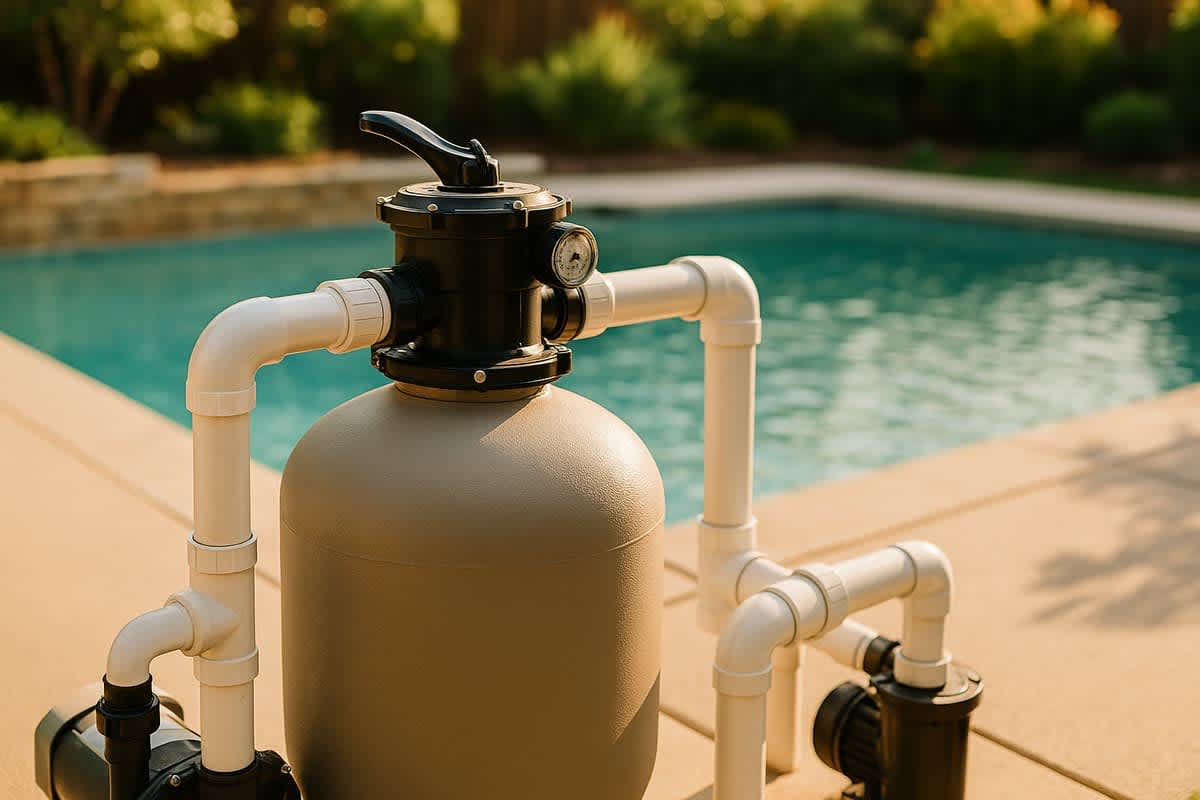
What is a pool sand filter? Cost, maintenance, benefits
What is a pool sand filter? Cost, maintenance, benefits
$150 – $600 for filter unit
$300 – $1,200 total installed cost
$50 – $150 annual maintenance

Average pool sand filter cost
A pool sand filter is one of the most popular and affordable filtration systems for both above-ground and in-ground swimming pools. It works by pushing water through a bed of specially graded sand, which traps dirt, debris, and particles as small as 20 to 40 microns. Most pool owners spend $150 to $600 for the filter unit alone, with professional installation bringing total costs to $300 to $1,200 depending on pool size and system complexity.
| Cost category | Average cost |
|---|---|
| Sand filter unit only (above-ground pool) | $150 – $400 |
| Sand filter unit only (in-ground pool) | $300 – $600 |
| Professional installation | $150 – $600 |
| Total installed cost | $300 – $1,200 |
| Replacement filter sand (50 lb bag) | $10 – $25 |
| Annual maintenance cost | $50 – $150 |
Sand filters have remained a go-to choice for decades because they require less maintenance than cartridge or diatomaceous earth (DE) filters, and the filter media (sand) is inexpensive to replace. Understanding how they work, what they cost, and how to maintain them will help you decide if a sand filter is the right choice for your pool.
How a pool sand filter works
A pool sand filter uses a large tank filled with specially graded silica sand to remove impurities from pool water. The pool pump pushes water into the top of the filter tank, where it flows down through the sand bed. As the water passes through, particles of dirt, algae, oils, and debris become trapped between the grains of sand. The clean, filtered water then exits through a set of lateral tubes at the bottom of the tank and returns to the pool.
| Component | Function |
|---|---|
| Filter tank | Houses the sand bed and withstands water pressure |
| Multiport valve | Controls water flow direction for filtering, backwashing, rinsing, and more |
| Silica sand | Traps particles between 20 to 40 microns in size |
| Lateral assembly | Collects filtered water at the bottom of the tank |
| Pressure gauge | Indicates when the filter needs backwashing |
The multiport valve on top (or side) of the filter is the control center. It typically has six settings: filter, backwash, rinse, waste, recirculate, and closed. During normal operation, the valve stays on "filter." When pressure builds up by 8 to 10 PSI above the clean starting pressure, it is time to backwash.
What is backwashing?
Backwashing reverses the flow of water through the sand bed, flushing trapped debris out through the waste line. This process takes about two to three minutes and is followed by a 30-second rinse cycle to resettle the sand. Backwashing is typically needed every one to two weeks during swimming season, depending on pool usage and environmental conditions.
Filtration particle size
Sand filters capture particles down to 20 to 40 microns in size. For comparison, a grain of table salt is about 100 microns, and a human hair is roughly 70 microns. While sand filters do not filter as finely as DE filters (which capture particles down to 2 to 5 microns) or some cartridge filters (10 to 15 microns), they are effective enough for most residential pools.
Adding a small amount of DE powder or a sand filter enhancer product to your sand filter can improve filtration down to approximately 3 to 5 microns, giving you near-DE filter performance at a fraction of the cost.
Pool sand filter cost by size
Sand filter prices depend primarily on the size of the filter tank, which is measured by the tank diameter and the sand capacity in pounds. Larger pools need bigger filters to handle the higher water volume and flow rate. Choosing the right size ensures proper filtration and prevents strain on your pump.
| Filter tank diameter | Sand required (lbs) | Recommended pool size (gallons) | Average unit cost |
|---|---|---|---|
| 16 inches | 100 lbs | Up to 10,000 | $150 – $250 |
| 19 inches | 150 lbs | 10,000 – 15,000 | $200 – $350 |
| 22 inches | 200 lbs | 15,000 – 20,000 | $250 – $400 |
| 24 inches | 250 – 300 lbs | 20,000 – 25,000 | $300 – $500 |
| 30 inches | 350 – 500 lbs | 25,000 – 35,000 | $400 – $600 |
| 36 inches | 500 – 600 lbs | 35,000+ | $500 – $800 |
A general rule is to slightly oversize your filter rather than undersize it. A bigger filter handles more debris, requires less frequent backwashing, and puts less strain on the pump motor. Most residential above-ground pools work well with 16- to 22-inch filters, while in-ground pools typically need 24- to 30-inch models.
Sand filter vs. cartridge filter vs. DE filter
Pool owners have three main pool filter types to choose from: sand, cartridge, and diatomaceous earth (DE). Each has distinct advantages in terms of cost, filtration quality, and maintenance demands. Sand filters offer the best balance of affordability and low maintenance, while DE filters provide the finest filtration.
| Feature | Sand filter | Cartridge filter | DE filter |
|---|---|---|---|
| Average unit cost | $150 – $600 | $200 – $800 | $400 – $1,200 |
| Filtration size | 20 – 40 microns | 10 – 15 microns | 2 – 5 microns |
| Media replacement frequency | Every 5 – 7 years | Every 1 – 3 years | Twice per year |
| Media replacement cost | $30 – $75 | $30 – $200 | $25 – $50 per recharge |
| Maintenance level | Low | Moderate | High |
| Backwashing required | Yes | No | Yes |
| Water clarity | Good | Very good | Excellent |
| Best for | Budget-conscious owners | Small to mid-size pools | Crystal-clear water priority |
When to choose a sand filter
Sand filters are ideal if you want a low-maintenance, budget-friendly option and are comfortable with good (though not the finest) water clarity. They are particularly well-suited for larger pools where cartridge filters would require very large, expensive cartridge elements. Sand filters also work well for pool owners who do not want to handle DE powder, which can be a respiratory irritant.
When to consider other filter types
If you have allergies, sensitive skin, or prefer exceptionally clear water, a DE filter might be worth the higher upfront cost and maintenance. Cartridge filters are a middle-ground option that eliminates the need for backwashing and the associated water waste, making them a good choice in areas with water restrictions.
Types of sand filter media
Traditional silica sand is the most common filter media, but several alternatives can improve filtration performance or extend the time between replacements. Each media type fits into the same standard sand filter tank, making upgrades straightforward.
| Filter media | Filtration size | Lifespan | Cost per fill |
|---|---|---|---|
| Silica sand (#20 grade) | 20 – 40 microns | 5 – 7 years | $30 – $75 |
| Zeolite sand | 3 – 5 microns | 5 – 7 years | $75 – $200 |
| Filter glass | 5 – 15 microns | 10+ years | $80 – $250 |
| Polyballs (filter fiber) | 10 – 15 microns | 3 – 5 years | $20 – $50 |
Silica sand
Standard #20 silica sand is the default media for pool sand filters. It is inexpensive, widely available, and effective for general pool filtration. You will need about 50 pounds of sand for every 1 square foot of filter area. Over time, the sand grains become smooth and lose their ability to trap fine particles, which is why replacement is recommended every five to seven years.
Zeolite sand
Zeolite is a naturally occurring volcanic mineral that filters down to 3 to 5 microns, rivaling DE filtration performance. It also has a natural ability to absorb ammonia and chloramines, which can reduce chemical odors. You typically need only about 50% of the weight of silica sand when filling a filter with zeolite.
Filter glass
Recycled glass media is an eco-friendly option that filters more finely than silica sand and lasts significantly longer, often more than 10 years. The glass particles have a slight negative charge that helps attract and hold fine particles. Filter glass also resists biofilm formation, keeping the filter cleaner between backwashes.
Benefits of a pool sand filter
Sand filters remain one of the most popular pool filtration systems for good reason. They offer several practical advantages that make them attractive to both first-time and experienced pool owners.
| Benefit | Details |
|---|---|
| Low upfront cost | Units start at $150, making them the most affordable filter type |
| Minimal maintenance | Only requires periodic backwashing and sand replacement every 5 – 7 years |
| Long media lifespan | Sand lasts 5 – 7 years; glass media lasts 10+ years |
| Simple operation | Multiport valve makes switching between modes easy |
| Durability | Fiberglass or thermoplastic tanks resist corrosion and last 10 – 20 years |
| Low replacement media cost | A full sand change costs $30 – $75 |
Ease of use is one of the biggest selling points. Unlike cartridge filters that need to be removed and hosed off regularly, or DE filters that require careful recharging after every backwash, sand filters simply need the multiport valve turned to "backwash" when pressure builds up. The entire backwash process takes less than five minutes.
Longevity is another major advantage. The filter tank itself can last 10 to 20 years with proper care, and the sand media only needs replacement every five to seven years. Compare that to cartridge filters, which require new cartridges every one to three years at a cost of $30 to $200 per cartridge.
Cost-effectiveness over time makes sand filters the most budget-friendly option for long-term pool ownership. Even factoring in the water used during backwashing, the total annual operating cost of a sand filter is typically $50 to $150, lower than both cartridge and DE filters.
Drawbacks to consider
While sand filters offer excellent value, they are not perfect for every situation. Understanding the limitations will help you make an informed decision.
| Drawback | Details |
|---|---|
| Lower filtration quality | Captures particles 20 – 40 microns (vs. 2 – 5 for DE) |
| Water waste from backwashing | Uses 200 – 500 gallons per backwash cycle |
| Larger physical footprint | Tanks are bulky compared to cartridge filters |
| Heavy when filled | A filled filter can weigh 200 – 500 lbs |
| Channeling risk | Water can carve paths through sand, reducing effectiveness |
The most significant drawback is filtration quality. Sand filters will not produce the sparkling, crystal-clear water that DE filters deliver. For most pool owners, the difference is negligible, but swimmers with sensitive skin or those who demand pristine clarity may notice it.
Water waste during backwashing can also be a concern. Each backwash cycle sends approximately 200 to 500 gallons of water to waste, which adds up over a swimming season. In drought-prone areas or regions with water restrictions, this may make a cartridge filter (which requires no backwashing) a better choice.
Pool sand filter maintenance
Maintaining a sand filter is straightforward and requires far less effort than other filter types. Regular backwashing, occasional chemical cleaning, and periodic sand replacement are the three pillars of sand filter maintenance.
| Maintenance task | Frequency | Estimated cost |
|---|---|---|
| Backwashing | Every 1 – 2 weeks (or when pressure rises 8 – 10 PSI) | Free (water cost only) |
| Chemical sand cleaner | 2 – 4 times per year | $10 – $25 per treatment |
| Inspect and clean multiport valve | Annually | Free (DIY) |
| Replace spider gasket (multiport valve) | Every 3 – 5 years | $10 – $30 |
| Full sand replacement | Every 5 – 7 years | $30 – $75 (DIY) or $100 – $250 (professional) |
| Replace laterals | As needed (signs of sand returning to pool) | $20 – $80 |
How to backwash a sand filter
Backwashing is the most frequent maintenance task and the most important one for keeping your filter performing well. Follow these steps:
- Turn off the pool pump completely.
- Turn the multiport valve to the "Backwash" position.
- Attach a backwash hose to the waste port if one is not already connected.
- Turn the pump back on and run it for two to three minutes, or until the water in the sight glass runs clear.
- Turn off the pump again.
- Set the multiport valve to "Rinse" and run the pump for 30 seconds.
- Turn off the pump, return the valve to "Filter," and restart the pump.
Never turn the multiport valve while the pump is running. Doing so can damage the valve's internal gaskets and cause leaks, leading to costly repairs.
When to replace the sand
Several signs indicate it is time for a sand change. If your pool water stays cloudy despite proper chemical balance, if the filter pressure does not drop after backwashing, or if you notice sand returning to the pool through the return jets, the sand has likely worn out or the laterals may be cracked.
A full sand change is a manageable DIY project that takes about one to two hours. You will need to scoop out the old sand, inspect the laterals for cracks, and add the correct amount of new #20 silica sand. Alternatively, a pool service professional will charge $100 to $250 for the job, including sand.
Installation considerations
Installing a pool sand filter involves more than just placing the tank near the pool. Proper sizing, plumbing connections, and placement all affect performance and longevity.
| Installation factor | Details |
|---|---|
| Pump compatibility | Match the filter's flow rate (GPM) to the pump's output |
| Placement | Install on a level surface near the pool equipment pad |
| Plumbing connections | Typically 1.5-inch or 2-inch PVC pipe |
| Electrical requirements | No separate electrical needed (runs off the pool pump) |
| Drainage for backwash | Need a waste line running to a drain, yard, or sewer connection |
| DIY vs. professional install | DIY saves $150 – $600 in labor costs |
Sizing your sand filter correctly
The most common mistake pool owners make is buying a filter that is too small. An undersized filter creates excessive pressure, forces more frequent backwashing, and shortens the lifespan of both the filter and the pump. As a guideline, the filter's flow rate (measured in gallons per minute, or GPM) should match or exceed the pump's flow rate.
To calculate the minimum flow rate your filter needs, divide your pool's total volume in gallons by 480 (which represents an 8-hour turnover rate in minutes). For a 20,000-gallon pool, that equals approximately 42 GPM. Choose a filter rated for at least that flow rate.
Above-ground vs. in-ground pool sand filters
Above-ground pool sand filters are generally smaller, lighter, and less expensive, with prices starting around $150. Many come as a combo unit with an integrated pump, costing $250 to $500 for the complete system. In-ground pool sand filters are larger, built to handle higher pressures, and typically cost $300 to $600 or more for the filter tank alone.
| Pool type | Filter unit cost | Combo unit (with pump) | Typical filter size |
|---|---|---|---|
| Above-ground | $150 – $400 | $250 – $500 | 16 – 22 inches |
| In-ground | $300 – $600 | $500 – $1,000+ | 24 – 30 inches |
Common sand filter problems and solutions
Sand filters are reliable, but occasional issues can arise. Most problems are simple to diagnose and inexpensive to fix.
| Problem | Likely cause | Solution | Repair cost |
|---|---|---|---|
| Sand in the pool | Cracked lateral or standpipe | Replace the damaged lateral(s) | $20 – $80 |
| High pressure that won't drop | Calcified or clumped sand | Chemical clean or replace sand | $10 – $75 |
| Cloudy water after filtering | Worn sand or channeling | Replace sand or use filter enhancer | $15 – $75 |
| Leaking multiport valve | Worn spider gasket or o-ring | Replace gasket | $10 – $30 |
| Filter runs continuously without cleaning | Clogged or channeled sand bed | Deep clean or replace sand | $10 – $75 |
The most common issue is sand returning to the pool, which almost always indicates a broken lateral. Laterals are the slotted tubes at the bottom of the filter that allow water to pass through while keeping sand inside. They are inexpensive parts, but replacing them requires removing all the sand from the tank first.
How long does a pool sand filter last?
A well-maintained sand filter tank can last 15 to 20 years or more. The tank itself rarely fails; it is the internal components and the sand media that require periodic attention.
| Component | Expected lifespan |
|---|---|
| Filter tank | 15 – 20+ years |
| Silica sand media | 5 – 7 years |
| Glass filter media | 10+ years |
| Multiport valve | 8 – 15 years |
| Spider gasket | 3 – 5 years |
| Laterals | 10 – 15 years |
| Pressure gauge | 2 – 5 years |
Keeping up with regular backwashing, avoiding running the pump dry, and winterizing the filter properly in cold climates will maximize the lifespan of every component. Storing the filter indoors or covering it during the off-season also prevents UV degradation of the tank and valve.
Frequently asked questions
How often should I run my sand filter?
Run your sand filter for 8 to 12 hours per day during swimming season, which allows the entire pool volume to circulate through the filter at least once (called a "turnover"). During periods of heavy use, high temperatures, or after adding chemicals, you may need to run it longer. Keep in mind that running your filter affects your pool pump operating costs.
Can I use regular sand in a pool filter?
No. Pool sand filters require #20 silica sand, which has a specific grain size of 0.45 to 0.55 mm. Play sand, beach sand, or construction sand are the wrong size and shape. They will either pass through the laterals into the pool or clog the filter and restrict water flow.
How much sand does a pool filter need?
The amount depends on the filter size. A typical 19-inch above-ground pool filter needs about 150 pounds of sand, while a 24-inch in-ground filter needs 250 to 300 pounds. Always check your owner's manual for the exact amount, as overfilling or underfilling can reduce performance.
Is a sand filter better than a cartridge filter?
It depends on your priorities. Sand filters are cheaper upfront, require less hands-on maintenance, and handle larger pools well. Cartridge filters provide finer filtration, waste no water (no backwashing), and are better for smaller equipment areas. Neither is universally "better"; the right choice depends on your pool size, budget, and maintenance preferences.
Can I switch from a sand filter to a cartridge filter?
Yes, but the switch requires replacing the entire filter unit and possibly adjusting the plumbing. The plumbing connections are typically the same size, making the swap relatively straightforward. Budget $200 to $800 for the new cartridge filter plus $100 to $300 for professional installation if needed.
Why is my pool still cloudy after running the sand filter?
Persistent cloudiness could indicate worn-out sand (if the sand is more than five years old), channeling within the sand bed, a chemical imbalance, or insufficient run time. Start by testing your water chemistry, then backwash the filter. If the problem continues, try a deep chemical cleaning of the sand or replace it entirely. For ongoing water clarity issues, scheduling regular pool maintenance can help identify and resolve problems early.